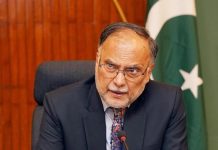
Anjum Nisar asks govt to employ other policy tools to tame economic volatility
ISLAMABAD
The Federation of Pakistan Chambers of Commerce & Industry’s Businessmen Panel (BMP) has emphasized that the central bank’s stringent monetary policy has adversely affected the businesses and economy for the last several years, stressing the needs to employ other policy tools to tame the economic volatility.
Addressing a delegation of various trade and industrial associations, FPCCI former president and BMP Chairman Mian Anjum Nisar pointed out that despite the successful completion of IMF past several programs and high policy rate, Pakistan remains overwhelmed with issues of dwindling exports and economic instability. This phenomenon well-establishes the fact that the government needs to employ other policy tools to tackle the low growth of economy.
He advocated for the lower markup rate to alleviate the financial burden on the business community and stimulate economic activity.
The BMP Chairman urged the central bank to implement a substantial reduction in the monetary policy rate, terming the current meager reduction in key policy rate as very depressing disappointing for the trade and industry.
The FPCCI former president said that the slash in discount rate announced recently was not enough to compete the regional countries, since the businessmen, was expecting a huge reduction in the monitory policy rate in line with the neighboring countries in view of decline in inflation, which has come down to single digit.
He advised the State Bank of Pakistan to announce a substantial reduction in interest rate by at least 300 basis points to bring the existing interest rate down in the next monetary policy statement as the inflation continues to descend to reach 9.6 percent in August whereas the Moody’s recently upgraded local and foreign currency issuer and senior unsecured debt ratings to Caa2 from Caa3.
Anjum Nisar highlighted that the tight monetary policy, combined with the government’s significant domestic borrowing, has left minimal room for business growth.
He stressed the urgent need for the government to freeze both domestic and foreign borrowing and to devise a comprehensive strategy to showcase Pakistan’s economic potential to international investors.
“The current low levels of domestic investment have sent negative signals to potential foreign investors,” Anjum Nisar said. “If the government is serious about achieving an economic turnaround, it must take immediate steps to address these issues.”
He proposed a 300-500 basis points reduction in the policy rate, potentially bringing it down to 15 percent, a level last seen several years ago. This anticipated cut is supported by several favorable economic indicators, including a significant decline in inflation rates.
On the external front, the current account deficit has improved remarkably, narrowing by 95 percent in the first two months of this fiscal year.
This reduction has contributed to the stability of the rupee against the US dollar.
The IMF emphasized the need to maintain a tight monetary policy for continued stability. However, the IMF suggested that this stance could be reassessed if inflation continues to decrease and the foreign exchange market remains stable.
Anjum Nisar also pointed out a decline in yields for government securities in both primary and secondary markets since the last monetary policy announcement. In the primary market, yields across various tenors have decreased. Similar trends have been observed in the secondary market.
He lamented that the cost of production has surged to its highest level in years due to the depreciation of the rupee against the dollar and record-high interest rates, leading to a slowdown in economic growth. Nisar called for a considerable reduction in the key policy rate to provide the private sector with access to low-cost borrowing.
He recommended that the SBP should target core inflation; non-food non-energy; for operational guidance. The SBP needs to strip out volatile changes in particular prices to distinguish inflation from temporary fluctuations in inflation. Efforts need to be made to control price manipulation and hoardings in liaison with the respective federal and provincial government departments. An active and efficient Competitive Commission of Pakistan and effective price control mechanisms also need to play their due role. He said that SBP should focus on core inflation rather than general inflation on an immediate basis as these exclude the most volatile components of the basket. The government must ensure the effectiveness of price control measures through vigilant actions against hoarding and malpractices. He explained that despite the progressive and major hikes in the policy rates, general inflation remained stubbornly-high and didn’t respond to the policy rate.
He was of the view that although the inflation has drastically come down, after touching 38 percent but the ease in inflation was not because of SBP’s tight monetary policy stance. “The government risks missing its annual growth targets in major sectors unless it takes decisive action to lower energy prices for local industries, ease the cost of production, and resolve the liquidity crunch through timely refunds,” Anjum Nisar warned.
He also advocated for improved ease of doing business, a consistent energy tariff policy, and a relaxed import policy for industrial raw materials to promote industrialization and enhance exports.