Sanctions, instability and external meddling are still problems for Ahmed al-Sharaa, one year after Assad’s fall
Damascus
If ubiquity and handshakes were the only measures of success, Ahmed al-Sharaa would be diplomat of the year.
Since he formally became president of Syria on 29 January 2025, the former leader of Hayat Tahrir al-Sham – a jihadist group with an al-Qaida lineage – has made a total of 21 public international trips to 13 countries. These include a visit to the UN general assembly, the climate change conference in Brazil, and numerous Arab summits.
In the latest sign of the goodwill directed towards Syria’s rebirth, envoys from all 15 members of the UN security council were in Damascus last week to mark the anniversary of the fall of Bashar al-Assad. The display of unity was a remarkable moment: since 2011 no issue has divided the security council more bitterly than Syria.
The visit was also an acknowledgment of the role Syria and its diaspora can play in bringing stability to the Middle East.
But ultimately the test will be whether Sharaa is able to translate this curiosity and goodwill into something tangible for the Syrian people in terms of lifted sanctions, internal stability and freedom from external meddling, whether by Israel, Iran or Sharaa’s potential ideological partner Turkey.
On the investment front, overseas pledges are rolling in. Saudi Arabia has promised investments worth more than $6bn (£4.5bn). Qatar is helping to revive the oil and gas industry and the final set of US sanctions is likely to be lifted in a vote before Christmas. But such is the chaos, Syria’s central bank admits it does not know the country’s true GDP.
The influx of Gulf investment is dependent on Sharaa continuing on a path of internal reconciliation and trust-building, far removed from the extremist threat. At the same time he has to show his still-reeling country is not being used as a base from which either Islamists in the south can threaten Israel or from which Kurds in the north will threaten Turkey.
In this task he has gained the unlikely support of Donald Trump, who has promised to visit Damascus soon. Sharaa has already met Trump three times, including a critical meeting in November in the White House, becoming the first Syrian president to visit the Oval Office since 1948.
“He comes from a very tough place, and he’s a tough guy. I like him,” Trump gushed when they met.
With his usual stream of consciousness, Trump continued: “We’ll do everything we can to make Syria successful, because that’s part of the Middle East. We have peace now in the Middle East – the first time that anyone can remember that ever happening.”
Trump also obligingly brushed aside Sharaa’s controversial history. “We’ve all had rough pasts,” he said, as if property contract disputes in New York were on a par with Sharaa’s military turf war in Raqqa with the leader of Islamic State (Isis), Abu Bakr al-Baghdadi, in which Sharaa lost 1,200 fighters.
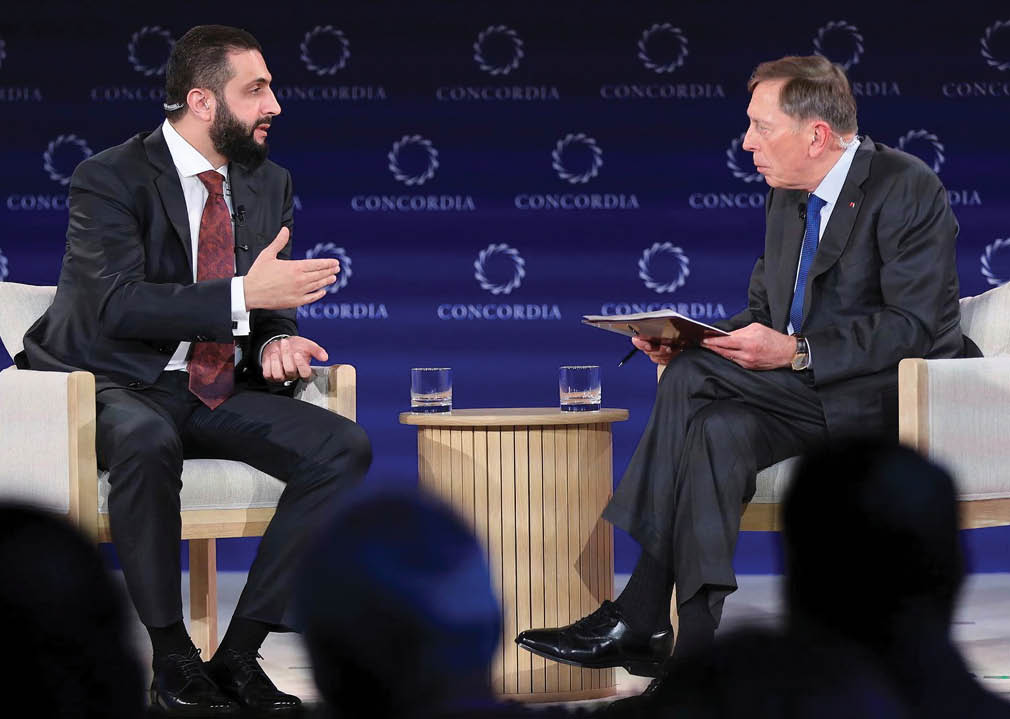
Perhaps the most striking of Sharaa’s many meetings was on stage in New York in September when he was interviewed by Gen David Petraeus, the former CIA director and retired army general who commanded US forces in Iraq while Sharaa was imprisoned there with other members of al-Qaida.
Petraeus showed concern for the Syrian leader’s personal wellbeing, asking whether he was getting enough sleep. He added his former prisoner had “many fans” and that he was one of them. Sharaa said with a smile when asked about their shared past: “At a time, we were in combat and now we move to discourse.”
“We cannot judge the past based on the rules of today and cannot judge today based on the rules of the past,” the Syrian president said.
That willingness to reject the rules of the past is reflected in the remarkable joint intelligence operations Syria’s interior ministry conducted alongside the US last month, locating 15 Isis weapons caches in southern Syria.
The concern is that external pressures are hampering Sharaa in his daunting task of keeping the country unified. In the south, Israel remains convinced Islamists are preparing terrorist attacks, while in the north, Turkey is impatient to see the strong Kurdish Syrian Democratic Forces (SDF) either disarmed or fully integrated into the Syrian army.
In both instances the White House is urging the external actors to be patient. In the case of Israel the fear in Damascus is it is intent on weakening Syria to the point it fragments, with a Druze-dominated rump state in the south.
In total Syria has been hit by nearly 1,000 Israeli airstrikes, including on the capital, and faced more than 600 ground incursions.