WASHINGTON
US President Donald Trump’s claim that Iran will soon have a missile that can hit the United States is not backed by U.S. intelligence reports, and appears to be exaggerated, according to three sources familiar with the reports, casting doubt on part of his case for a possible attack on the Islamic Republic.
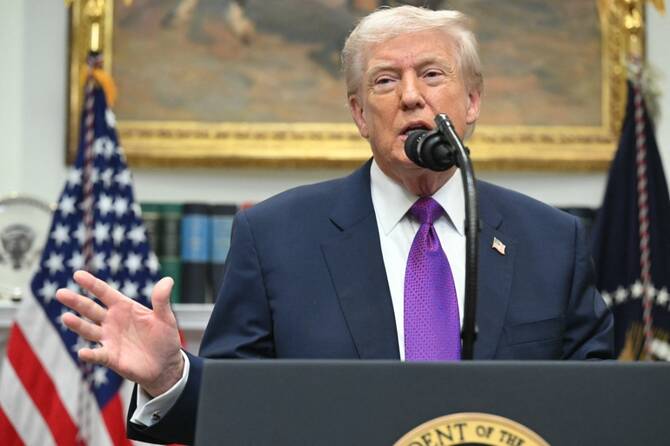
In his State of the Union address to Congress on Tuesday, Trump began making his case to the American public for why the U.S. could launch strikes against Iran, saying Tehran was “working on missiles that will soon reach” the United States.
But there have been no changes, two sources said, to an unclassified 2025 U.S. Defense Intelligence Agency assessment that Iran could take until 2035 to develop a “militarily viable intercontinental ballistic missile” (ICBM) from its existing satellite-lofting space-launch vehicles (SLV).
“President Trump is absolutely right to highlight the grave concern posed by Iran, a country that chants ‘death to America,’ possessing intercontinental ballistic missiles,” said White House spokesperson Anna Kelly.
One source said that even if China or North Korea – which closely cooperate with Iran – provided technological assistance, Iran would probably take up to eight years at the earliest to produce “something that is actually ICBM level and operational.”
The sources, who spoke on condition of anonymity in order to discuss sensitive intelligence, said they were unaware of any U.S. intelligence assessments that Iran was developing a missile that could soon range the U.S. homeland but did not rule out the possibility of a new intelligence report they were unaware of.
The New York Times first reported that U.S. intelligence agencies believe Iran is probably years away from having missiles that can hit the United States.
RUBIO SAYS IRAN ON ‘PATHWAY’ TO WEAPONS THAT CAN REACH U.S.
Trump’s claim about Iran’s missile capability came as representatives from the U.S. and Iran negotiate over Tehran’s nuclear program, with no signs of a breakthrough that could avert potential U.S. strikes amid a massive military buildup in the region.
The U.S. president has done little to explain publicly why he might be leading the U.S. into its most aggressive action against the Islamic Republic since its 1979 revolution.
In his address on Tuesday, Trump pointed to Tehran’s support for militant groups, its killing of protesters and the country’s missile and nuclear programs as threats to the region and the United States.
Without providing evidence, Trump said that Tehran was beginning to rebuild the nuclear program that he claimed had been “obliterated” by U.S. airstrikes last June on three major sites involved with uranium enrichment.