Karachi
The Arts Council of Pakistan Karachi hosted an extended scholarly lecture by eminent religious scholar, researcher, and literary figure Ayatullah Allama Syed Aqeel- ul-Gharavi on the topic “The Genre of Salam in Urdu Poetry: A Study in Creative Tradition and Critical Insight” at Haseena Moin Hall.
The event was attended by a large gathering of writers, poets, researchers, academics, students, and literature enthusiasts. The proceedings were conducted by Syed Javed Hassan, while President Arts Council of Pakistan Karachi Mohammad Ahmed Shah warmly welcomed the distinguished speaker.
Delivering his keynote address, Ayatullah Allama Syed Aqeel-ul-Gharavi said that the literary heritage of Salam in Urdu poetry is exceptionally rich and extensive. While a considerable body of this literature has already been published, a substantial portion still awaits scholarly research and documentation.
He noted that although Salam may not rival the ghazal in terms of quantity, it possesses a distinctive literary and intellectual significance in both quality and substance.
He explained that most genres of Urdu poetry are rooted in Persian literary traditions and influenced by Arabic literature, with the ghazal itself evolving from Arabic into Persian before becoming an integral part of Urdu poetry.
Elaborating on the Arabic term Qasida, he said that its meaning is much broader than its conventional understanding in Urdu, as it is used for various poetic forms including manqabat, marsiya, nauha, and, in some instances, even the ghazal.
Ayatullah Al-Gharavi emphasized that Salam is not derived from the ghazal, nor is it a subgenre of it. Rather, several classical poetic forms—including Qasida, Hamd, Naat, Salam, Marsiya, and Manqabat—share the same prosodic structure, differing only in subject matter and style.
Highlighting the distinction between the ghazal and Salam, he stated that while the ghazal primarily reflects worldly emotions, romance, and human experience, Salam represents spirituality, reverence, purity, and divine love. He added that Salam embodies higher moral and spiritual consciousness, setting it apart as an independent literary genre.
Encouraging further academic research, he observed that numerous Salams and Qasidas have been composed in identical poetic metres, offering scholars valuable opportunities to explore new literary and critical dimensions within Urdu and Persian poetry.
Speaking on Marsiya and Salam, Ayatullah Al-Gharavi stressed that while expressing the grief of the Ahl al-Bayt (AS) remains an essential element of the tradition, greater emphasis should be placed on portraying the patience, steadfastness, courage, and moral grandeur of Imam Hussain (AS).
He remarked that Imam Hussain (AS) should not be presented merely as a symbol of suffering and helplessness; rather, the world should recognize his unwavering resolve, dignity, and exemplary character.
He further stated that mourning reflects the emotional state of the believers, but literature should primarily preserve and project the greatness and resilience of Imam Hussain (AS). He also referred to Mirza Ghalib’s distinctive literary treatment of this theme.
Addressing the gathering, Mohammad Ahmed Shah, President of the Arts Council of Pakistan Karachi, described Ayatullah Allama Syed Aqeel-ul-Gharavi as an extraordinary scholar whose speeches combine profound knowledge, eloquence, logical reasoning, and intellectual depth.
He said the audience has had the privilege of listening to his lectures on philosophy, Allama Iqbal, Islam, science, and numerous other subjects, each offering fresh intellectual perspectives.
He praised the scholar’s command over logic, philosophy, literature, and Islamic studies, noting that the lecture had opened new avenues for understanding the literary significance of Salam and highlighted the need for further scholarly dialogue and research.
He remarked that even after listening to Allama Aqeel-ul-Gharavi for hours, audiences are left intellectually inspired and eager for more, as every statement he makes generates new questions and deeper reflection.
Mohammad Ahmed Shah recalled the period when Allama-ul-Gharavi was unable to visit Pakistan and said that many admirers continued to benefit from his lectures delivered from the United Kingdom.
He expressed delight at the scholar’s return to Pakistan and noted that his presence had further enhanced the academic stature of the Arts Council.
He added that at a time when meaningful intellectual discourse is steadily diminishing, such scholarly engagements are more important than ever.
He expressed his desire to organize a special interactive session with university students during Allama-ul-Gharavi’s next visit, allowing young people to engage directly with him and strengthen the culture of critical thinking and academic dialogue.
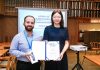
At the conclusion of the event, Mohammad Ahmed Shah escorted Ayatullah Allama Syed Aqeel-ul-Gharavi on a visit to the Josh Malihabadi Library, where he introduced him to its rare collection of books, manuscripts, and research material.
Appreciating the Arts Council’s contribution to literature and scholarship, Ayatullah-ul-Gharavi described the Josh Malihabadi Library as a valuable academic resource for scholars, researchers, and students alike.