ISLAMABAD
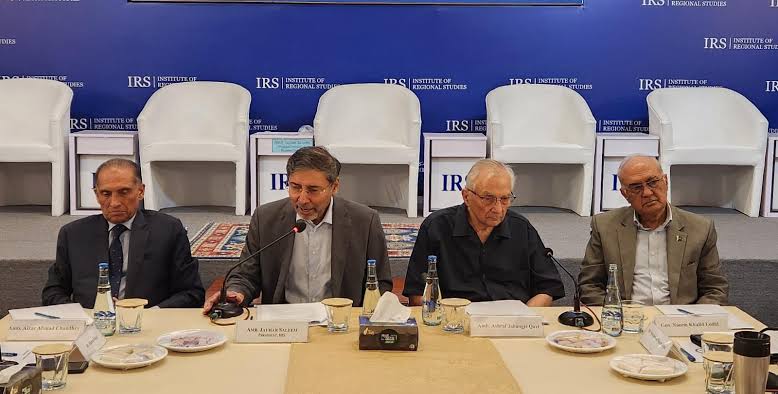
The Institute of Regional Studies (IRS) organized a roundtable discussion titled “India: From Strategic Relevance to Irrelevance?”, bringing together former diplomats, military experts, and scholars to examine evolving regional and global strategic dynamics, particularly in the wake of developments in South Asia during 2025. Opening the session, President IRS Ambassador Jauhar Saleem observed that Pakistan is increasingly being perceived internationally as a responsible and peace-oriented state.
He argued that changes in the United States’ strategic approach towards India since May 2025 have created new opportunities for Pakistan to strengthen its strategic, political, and economic standing. He emphasized that Pakistan’s strategic relevance should be viewed independently of India and leveraged through internal consolidation and prudent policymaking.
Former envoy to US, China and India, Ambassador Ashraf Jahangir Qazi discussed India’s defence relationship with the United States and argued that New Delhi’s international influence has diminished following what he described as setbacks during Operation Sindoor. He maintained that India has also lost ground in shaping China’s strategic calculus and is increasingly viewed as a source of regional instability.
Ambassador Qazi suggested that India lacks support from Washington for any future military escalation and asserted that Pakistan’s technological capabilities have been strengthened through cooperation with China.
He also proposed that, given the limited utility of Chabahar Port, regional connectivity initiatives should instead focus on Gwadar.
Former Foreign Secretary Ambassador Aizaz Ahmad Chaudhry cautioned that India’s current decline in strategic relevance may be temporary rather than permanent.
He attributed the shift primarily to changes in US strategic priorities under President Donald Trump, including a more constructive US-China approach, as well as growing regional discontent with New Delhi.
Ambassador Chaudhry further argued that India has gradually lost its traditional leadership position in the Global South to China. Reflecting on the May 2025 crisis, he observed that Pakistan’s response demonstrated how technological advances have fundamentally transformed the character of asymmetric warfare.
General (Retd.) Naeem Khalid Lodhi stressed that regardless of international perceptions, India will continue to remain strategically significant for Pakistan. He argued that India is already pursuing what he termed “Sindoor 2.0” through proxy actors and non-state elements operating against Pakistan.
He maintained that the United States is unlikely to distance itself completely from India and recommended that Pakistan seek greater Chinese involvement on key issues such as Jammu and Kashmir and the Indus Waters Treaty.
He also emphasized the importance of keeping diplomatic channels with India open through sustained efforts towards dialogue.
Professor Mujeeb Afzal argued that India’s strategic importance has been overstated by sections of the US media and Indian policymakers. He contended that expectations of India as an emerging great power have not been matched by its performance, exposing limitations in its strategic capabilities.
According to Dr. Afzal, India’s importance to the United States has largely depended on Washington’s perception of China as a strategic competitor.
He further observed that India’s foreign policy has historically displayed resistance to external influence, accompanied by strong strategic assertiveness. While describing India as a significant regional power, he argued that it has often been reluctant to assume broader regional responsibilities. Dr. Khurram Iqbal discussed what he described as a significant shift in US strategic thinking, arguing that Washington’s emphasis has moved towards reinforcing its own centrality in the Pacific rather than India’s role in the Indo-Pacific.
He suggested that questions surrounding India’s military credibility following Operation Sindoor, together with policy differences with Washington—including India’s reluctance to acknowledge President Trump’s role in the May 2025 ceasefire and perceived inconsistencies in its position on the Russia-Ukraine conflict—have contributed to a decline in India’s credibility as a strategic partner.
The discussion concluded that changing geopolitical realities are reshaping strategic alignments in South Asia and beyond. Participants emphasized the importance of Pakistan pursuing a balanced foreign policy, strengthening its domestic capacities, enhancing regional connectivity, and remaining prepared to capitalize on emerging strategic opportunities while maintaining diplomatic engagement with neighbouring countries.