Remarks court should not take up political matters
ISLAMABAD
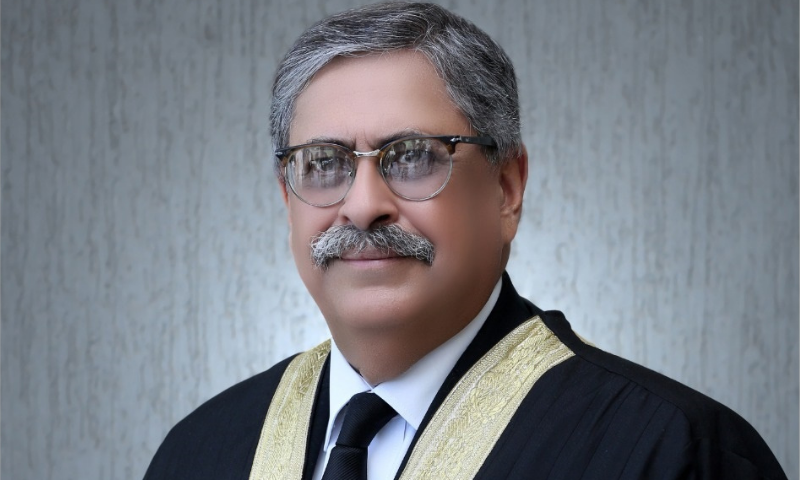
Supreme Court of Pakistan judge Justice Athar Minallah has released his detailed note and remarked that the court should not take up political matters.
Justice Athar Minallah was one of the four judges of the top court who had recused himself from a nine-judge bench hearing election date suo motu notice regarding a delay in the announcement of a date for elections in Punjab and Khyber Pakhtunkhwa over a month ago.
Justice Minallah now released the 25-page detailed note observing that the court should not hear political matters on its own. “Objection was raised to suo motu notice which was disposed of,” he added
While recusing himself from the bench over a month ago, Justice Athar Minallah in his dissenting note then had said that the order of Chief Justice Umar Ata Bandial “does not appear to be consistent with the proceedings and the order dictated” in the open court.”
The SC judge had noted that the questions raised before them cannot be considered in isolation because questions regarding the constitutional legality of the dissolution of the provincial assemblies of Punjab and KP cannot be ignored. “Were they dissolved in violation of the scheme and principles of constitutional democracy before completion of the term prescribed under the Constitution of the Islamic Republic of Pakistan (‘the Constitution’)?”
Justice Minallah had said the questions regarding the legality of the dissolution involve far more serious violations of fundamental rights, adding “the matter before us is definitely premature, because it is pending before a Constitutional Court of a province, as noted in the opinion of my learned brother Yahya Afridi, J.”
He said the Chief Justice has the authority to constitute benches and clarified his position saying that it should be noted that he neither left the bench nor gave any such reasons in his brief note. Athar Minallah also remarked in his dissenting note that the apex court’s suo motu notice on Punjab and Khyber Pakhtunkhwa (KP) elections stood rejected by 4-3.
He remarked that there were three basic reasons to reject the notice. “The bench which heard the case was obligated to follow the basic principles enshrined in Article 184 (3), the court should handle political cases with great care to preserve its dignity, and it should also take the petitioner’s code of conduct and intentions into consideration,” he remarked.
The petitioners’ behaviour was not a solid reason to invoke Article 184 (3), he remarked. “The legitimacy of the court’s verdict solely depends on the public’s belief that the Court is an independent, impartial, and apolitical arbiter of disputes between political stakeholders,” said the judge. He also explained that issue of elections in Punjab and Khyber Pakhtunkhwa was political and was being adjudicated by a high court.
Earlier, Justice Minallah had distanced himself, along with Justice Yahya Afridi, Justice Mansoor Ali Shah, and Justice Jamal Ahmad Khan Mandokhail, from hearing the suo motu case regarding elections in Punjab and KP.
A three-member bench — comprising Chief Justice of Pakistan (CJP) Umar Ata Bandial, Justice Ijazul Ahsan and Justice Munib Akhtar — announced the reserved verdict on the PTI’s petition challenging the Election Commission of Pakistan’s order postponing the elections in Punjab and KP
The Supreme Court declared the ECP’s order postponing the provincial assembly elections until October 8 as “unconstitutional” and ordered the government to release Rs21 billion funds for elections in Punjab by April 10.