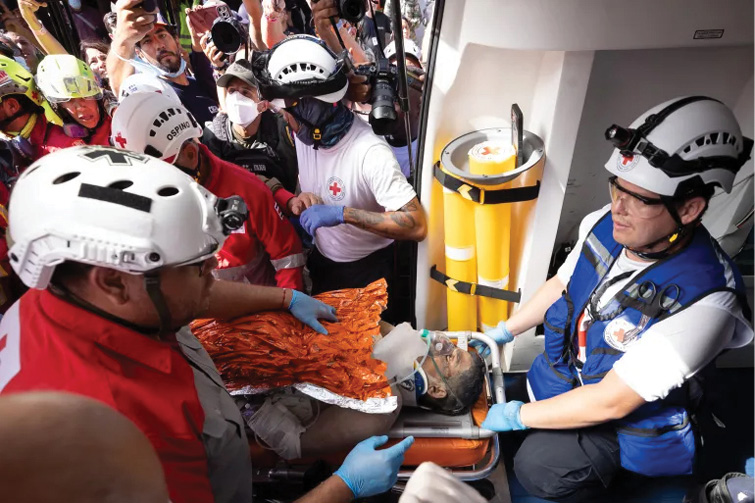
This week, the tragedy that befell three-year-old Ibrahim, who fell into a lidless manhole and died after a harrowing 15-hour rescue effort, has sent shockwaves through Karachi. Desperate citizens even pooled money for heavy machinery, since official responders were hampered by a lack of accurate sewer maps and crucial information about the city’s drainage layout.
In a predictable response, officials from the Karachi Metropolitan Corporation (KMC), the Town Municipal Corporation of Gulshan-i-Iqbal, the Karachi Water and Sewerage Corporation (KWSC) and district-level administrators were suspended overnight. The provincial minister for local government promised an investigation committee and demanded a list of all manholes along with their security status within 24 hours. But such gestures cannot plug the city’s open wounds. An audit of responsibility is overdue. The probe report (when it arrives) may name individuals responsible. Yet structural neglect predates every administration’s turn. This is not the failure of a single wrong turn. It is the failure of a system that places entire neighbourhoods beyond the threshold of basic safety.
According to recent reports, as many as 23 citizens have lost their lives in open drains and manholes in 2025 alone. In 2024, official records show at least 19 deaths due to similar incidents across Karachi.
The tragedy has been pinned on excavation work for the BRT Red Line Project. A KMC investigation concluded that BRT-related disruption had severely damaged drainage lines near NIPA. Temporary, two-foot covers placed over cleaning pits were inadequate. The project’s management rejected responsibility, contending that no excavation had taken place at that spot on the night in question and that sewerage lies outside their mandate.
So the blame is passed around like a blistered baton. While the mayor’s visit to Ibrahim’s family and his hollow apologies may momentarily ease public outrage, they do little to address the urgent need for systemic change.
Enough is enough. Words and suspensions will not plug these pits.
If politicians lack the will, the Sindh Assembly should legislate tougher standards for public works, routine drain audits and stiff penalties for negligence. The city must also embrace technology, from tamper-proof lids to ultrasonic scanning of its underground drains, to close these death traps.
Municipal agencies responsible for roads, sewerage, sanitation, and urban development must operate under a unified command rather than the maze of overlapping jurisdictions that allows blame-games to flourish. Above all, policymakers need to ensure equal protection for all citizens. Karachi’s poorest quarters cannot remain the hinterlands of neglect. If the state cannot ensure something as basic as a covered manhole, it has already failed its citizens. This calamity should serve as a test: can our institutions learn to protect the living rather than rush to cover up the dead?