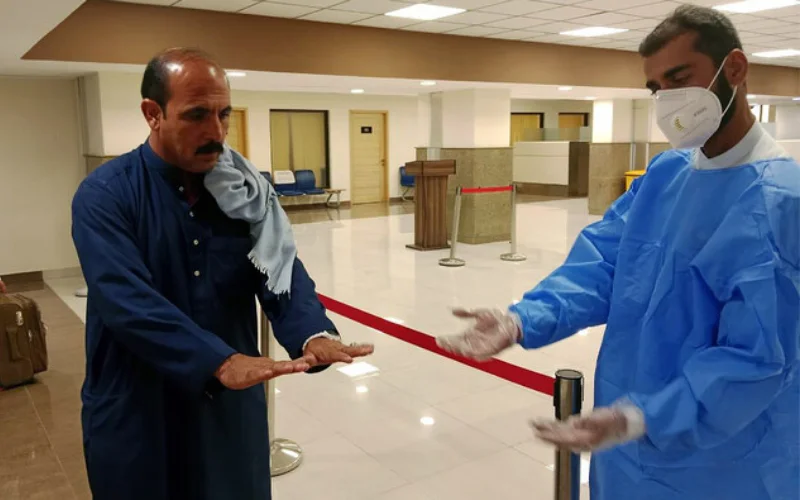
Singapore, Hong Kong, Thailand, and Malaysia authorities also ramp up airport screening to curb spread of virus
Islamabad
Pakistan has ordered strict and enhanced health surveillance at all entry points following regional alerts over the Nipah virus, a highly fatal zoonotic disease, the government said on Wednesday.
Nipah is classified as a priority pathogen by the World Health Organisation because of its ability to spark fast‑moving outbreaks, its fatality rate of 40% to 75%, and the fact that there is no approved vaccine or cure.
The virus, carried by fruit bats and animals such as pigs, can trigger a deadly brain-swelling fever in humans and can also spread directly from person to person through close contact. Several vaccines are in development but remain in testing.
In an advisory issued by Border Health Services–Pakistan under the Ministry of National Health Services, authorities cited reports of suspected Nipah virus cases in India’s West Bengal state and warned of the virus’s potential for cross-border transmission.
“In view of the recent regional alert regarding Nipah Virus (NiV)… and considering the high case fatality rate, zoonotic nature, and potential for human-to-human transmission, it has become imperative to further strengthen preventive and surveillance measures at Pakistan’s borders,” the advisory said.
The government has directed officials to enforce “strict and enhanced health surveillance at all points of entry with immediate effect,” covering international airports, seaports and land border crossings, according to the document dated January 28.
All incoming passengers, transit travellers, crew members and transport staff must undergo mandatory screening, and “no individual shall be allowed entry into Pakistan without health clearance by Border Health Services–Pakistan,” the advisory said.
Authorities have also ordered verification of travellers’ full travel and transit history for the previous 21 days, regardless of nationality. Officials were instructed to maintain “special vigilance for travellers originating from, or transiting through, Nipah-affected or high-risk regions.”
The advisory mandates thermal screening and clinical assessment at entry points, with staff told to watch for symptoms including fever, respiratory illness and neurological signs such as confusion or altered consciousness.
“Any individual consistent with suspected Nipah Virus case definition shall be immediately isolated at the Point of Entry, restricted from onward movement, and managed strictly in accordance with Infection Prevention and Control protocols,” it said.
It added that suspected cases are to be referred to designated isolation facilities or tertiary care hospitals, while aircraft, vehicles or vessels used by the patient must be disinfected under standard operating procedures.
The advisory further warned that any lapse in surveillance or infection control would be treated as “serious negligence” and said daily case or nil reports must be shared with national authorities, including the National IHR Focal Point. The measures will remain in force “until further orders issued by the Competent Authority,” it stated.