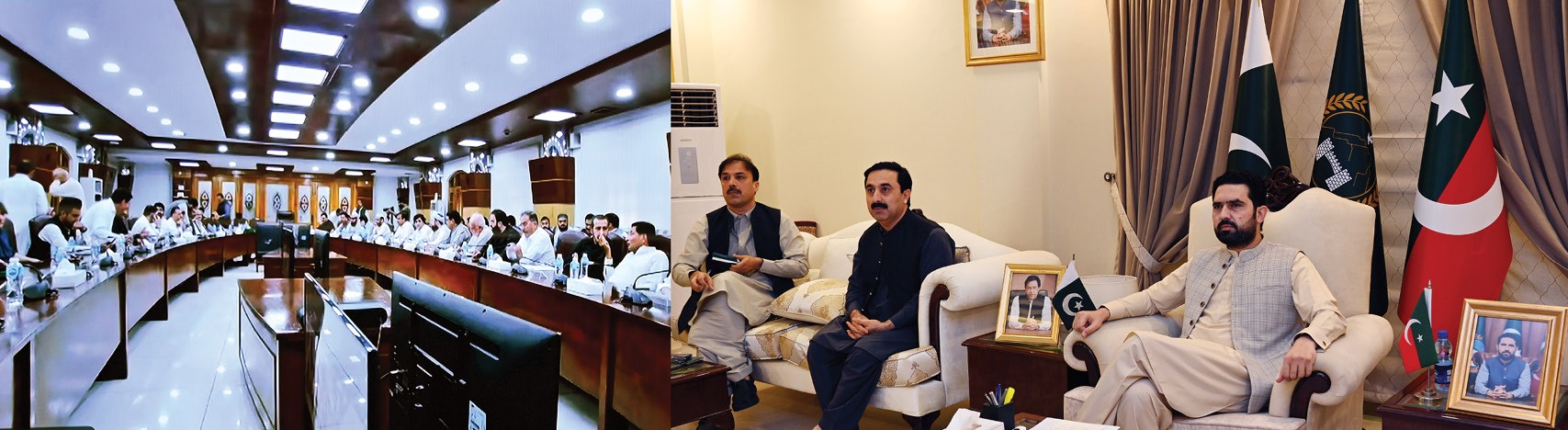
SCCI president Junaid Altaf participates in the meeting of Senate Standing Committee on Finance, stresses reduction in taxes ratio, EoDB
PESHAWAR
Sarhad Chamber of Commerce and Industry presented comprehensive proposals for the upcoming fiscal year 2026-27, emphasising the need of rationalization of various taxes, implementing the business friendly policies, facilitation for ease of doing business, industrial and business growth.
A 17 pager budget proposals document dubbed: ‘Enhancing Industrial Competitiveness, Trade Facilitation, and Business Environment in Khyber Pakhtunkhwa’ compiled by the chamber’s Research and Development Wing, asserting to address critical constraints faced by businesses in the province and to support a more competitive, transparent and growth-oriented economic environment, according to a press release here on Thursday.
The SCCI budget proposals focus on tariff rationalization, tax reforms, regulatory simplification, and institutional transparency.
According to the budget proposals, the chamber called for concrete reforms across income tax, sales tax, customs, and broader economic policy with the notion of improving investment climate, documentation as well as enhancing economic efficiency.
The proposals seek improvement in access to finance for Small Medium Enterprises Development (SMEs) in Khyber Pakhtunkhwa and recommended to increase atleast 20 percent of the total private sector credit while KP’s Advance-to-Deposit Ratio (ADR), currently approximately 0.9 percent despite contributing around 16 percent to national deposits, be enhanced to a minimum benchmark of 7-8 percent.
SCCI highlights in its proposals the strategic importance of the KP as gateway for regional trade with Afghanistan and Central Asia, therefore, it emphasis fast-track initiatives for development of border infrastructure, establishment of one-window operations, encompassing customs clearance, banking, insurance, warehousing, cold storage, testing laboratories, and quarantine services.
The chamber’s proposals call for establishment of an effective coordination mechanism between the federal and provincial authorities to improve the overall ease of doing business. It is recommended that a joint SIFC-SCCI coordination cell be set up to address investor grievances, streamline licensing processes, and reduce regulatory overlaps.
A drastic cut in custom duties on key industrial input such as printing ink and base proposed, with a notion to reduce production costs and improve the competitiveness of domestic manufacturing.
Similarly, the chamber sought changes in primitive custom classifications and legal provisions, citing that it is highly crucial to align policy frameworks with modern industrial practices.
At the institutional level, the proposals emphasized reforming the litigation framework of FBR and enhancing transparency through digitization to reduce compliance burdens and promote predictability in the tax system.
Furthermore, it called for rationalization taxes on petroleum dealers and regulating undocumented sectors such as furniture Expos, to ensure fairness, improve documentation and protect compliant businesses.
SCCI proposes comprehensive tax-reforms, including corporate tax rationalization, simplification of withholding taxes, harmonization of sale tax systems, as well as facilitation of SMEs, to promote investment and economic growth.
It is highly imperative to pay serious attention to KP through trade facilitation, Special Economic Zones Incentives, and revised tax thresholds for development of industries at regional level, according to the proposals.
President Junaid Altaf urged the government, and relevant authorities to incorporate the chamber’s proposals in the forthcoming FY Budget 2026-27.
The SCCI chief said the chamber’s proposals mainly focused on reducing the cost of doing business, encouraging investment, enhancing documentation, and promoting sustainable industrial development.
President Junaid Altaf emphasized timely and coordinated implementation of these reforms is highly imperative to achieving the fiscal stability and long-term economic resilience in Pakistan.
A day earlier, SCCI president Junaid Altaf, along with member of the executive committee Sajjad Zaheer participated in the meeting of the Senate Standing Committee on Finance, wherein he suggested the abolition of a 4 percent further sales tax on supplies to unregistered persons. The FBR is collecting around Rs 1-3 billion from further sales tax, which is mostly paid by registered companies.
The SCCI chief also proposed rationalization of withholding taxes and minimum taxes in the coming budget (2026-27). The withholding taxes under sections 148, 153, 236G, and 236H should be rationalized.
President Junaid Altaf informed the committee about the misuse of the Export Facilitation Scheme (EFS) by unscrupulous exporters. The FBR must abolish sections 7E and 7F of the Income Tax Ordinance for the growth of the real estate sector., he asserted.