ISLAMABAD
Pakistan’s rapidly expanding solar market is entering a new phase as businesses with existing photovoltaic systems increasingly look towards battery storage to make renewable electricity available beyond peak sunlight hours and gain greater control over energy costs.
The development could create a sizeable second-stage investment opportunity around the country’s already installed solar capacity, particularly among commercial and industrial consumers seeking to optimise self-generation, manage peak demand and reduce reliance on grid electricity during higher-cost periods.
Trina Storage, the energy-storage business of Trinasolar, said the growing installed solar base is driving increased interest in solar-plus-storage solutions, particularly for utility-scale projects and commercial and industrial microgrids. Recent research by Ember and Renewables First estimates Pakistan now has around 38GW of distributed solar capacity across residential, commercial, industrial and agricultural sectors.
The emerging storage market is already reflected in equipment imports. A Renewables First report estimates that Pakistan imported 4.6GWh of battery energy storage systems in 2025, up 220 percent year-on-year, indicating rapidly rising demand for technologies capable of storing electricity generated from renewable sources.
For businesses that already have solar installations, batteries could provide a way to extend the usefulness of existing assets rather than replace them. Storage can allow surplus daytime generation to be shifted to periods of higher demand, while also supporting more flexible energy management and, depending on system design, microgrid or backup applications.
However, industry experts point out that adding battery storage to an existing solar installation is not a simple plug-and-play exercise. The feasibility of a retrofit depends on the site’s electrical architecture, inverter configuration, electricity demand profile, equipment compatibility, control systems, safety requirements and the commercial objective of the project.
One approach increasingly suited to such retrofits is AC-coupled storage, where batteries operate alongside an existing solar photovoltaic system through a separate power conversion system. This can allow businesses to retain much of their existing solar infrastructure while adding storage, although compatibility between the battery, inverter, electrical systems and controls still needs to be assessed at the overall system level.
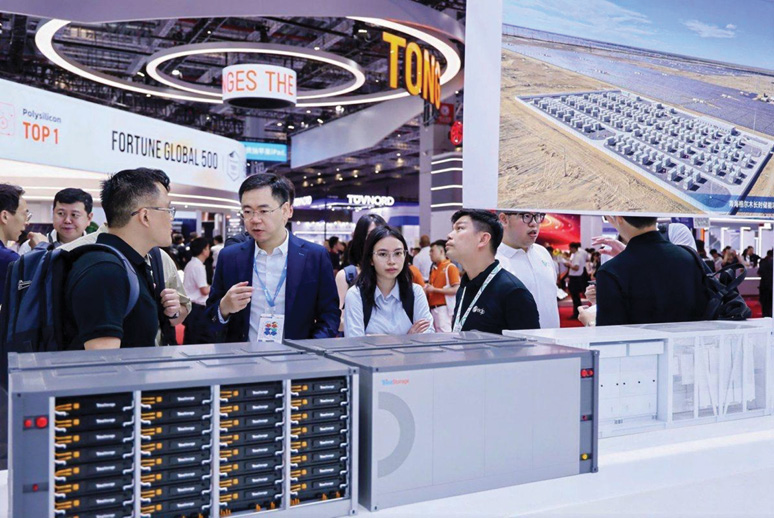
Trina Storage’s Elementa Series is designed for utility-scale and commercial and industrial applications and can be integrated into solar-plus-storage projects using Trina or third-party equipment, subject to the requirements of the individual project architecture.
The company has supplied more than 500MW of 700W-plus solar modules in Pakistan across commercial, industrial and residential applications and recently introduced its Vertex N G3 760W series. Globally, its energy-storage business was established in 2015 and has achieved BloombergNEF Tier 1 Energy Storage Manufacturer status for 10 consecutive quarters.