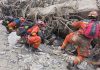
Three days after Wednesday’s disaster, families are still arriving at an army base in Nepal, with photographs and names, hoping someone can tell them whether the people they love are alive. 547 people have already been confirmed dead, five more in Tibet and almost 1,000 still missing. More than half of those unaccounted for are foreigners, many of them pilgrims travelling towards Mount Kailash and Lake Mansarovar
Roads have disappeared, bridges have been torn away and settlements buried underneath. Satellite analysis indicates that the lower section of a glacier high above the Lhende Khola collapsed, sending an avalanche down more than a kilometre before it turned into a debris flow powerful enough to reshape river channels far downstream. At one monitoring point, the river rose by as much as nine metres in half an hour.
To add to the tragedy, even the search for the dead has been interrupted by fear of another disaster. On Friday, rescuers withdrew temporarily as water accumulated behind debris and began spilling from a newly formed lake. Residents again climbed towards higher ground. More than 93,000 people are now estimated to need assistance while six health facilities have been damaged and eight health workers are missing.
There will be time to establish exactly why the glacier failed. Scientists should be given that time. As with other disasters widely recognised to be climate-related, it is unwise to jump to conclusions.
This caution, however, cannot erase what decades of measurements are showing across the Hindu Kush Himalaya. Glaciers in the region lost roughly 12 per cent of their area between 1990 and 2020, while ice loss has accelerated markedly since the turn of the century. Snow, glaciers, permafrost and mountain slopes are changing across a region on which enormous populations depend.
That people can live many kilometres from the initial collapse and still be overwhelmed before a conventional downstream warning reaches them narrates yet another cruel reality. Monitoring must therefore move higher up the mountain.
Nepal and China are already monitoring the new lakes and exchanging information. That cooperation should deepen. No frontier can stop an avalanche or hold back a river.
China’s considerable satellite and high-altitude monitoring capacity can strengthen a regional warning system in which information moves across borders before the water does.
Pakistan has every reason to watch closely. Its northern mountains contain thousands of glaciers and vulnerable valleys already being monitored for glacial hazards. What happened in Nepal should force harder questions than a simple acknowledgement of greenhouse gas emissions altering the Earth’s atmosphere. We need to ask ourselves whether our warning systems, roads, bridges, settlements and district administrations are changing quickly enough.