KARACHI
Mian Zahid Hussain, President Pakistan Businessmen and Intellectuals Forum and All Karachi Industrial Alliance, Chairman National Business Group Pakistan, Chairman Policy Advisory Board FPCCI, and Former Provincial Minister Information Technology, has welcomed the Pakistan–Saudi Arabia conclusion to raise Pakistan’s annual agricultural and food exports to the Kingdom to $3 billion annually within the next two years.
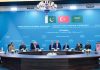
He said the Makkah Joint Defence Agreement, concluded among Pakistan, Saudi Arabia and Türkiye on August 7, has provided a foundation and direction to relations among the three countries.
Under this historic agreement, an armed attack on any one country will be considered an attack on all three, while cooperation in defence capabilities, technology and joint defence production will also be expanded.
The progress in agricultural and food trade between Pakistan and Saudi Arabia immediately after the defence agreement demonstrates that mutual trust is now being translated into strong economic partnership.
Mian Zahid Hussain said the efforts of Prime Minister Mian Muhammad Shehbaz Sharif to make agriculture and food security an important pillar of Pakistan–Saudi Arabia economic relations resulted in a high-level Saudi delegation visiting Islamabad from August 26 to 28.
The delegation, headed by Saudi Minister for Environment, Water and Agriculture Engineer Abdulrahman Al-Fadley, identified rice, halal meat, fresh fruits, fruit concentrates, animal feed and water-efficient agricultural technologies as priority sectors.
He said the confidence generated by the Makkah Defence Agreement is now being translated into investment, trade, secure supply chains and long-term procurement agreements. Pakistan has the capacity to meet a substantial portion of Saudi Arabia’s food requirements, while Saudi investment can modernise and develop Pakistan’s agriculture, livestock, food-processing and cold-chain sectors.
Mian Zahid Hussain said the target is enormous from an economic perspective because Pakistan’s total merchandise exports to Saudi Arabia amounted to approximately $692 million in 2025. Pakistan supplied the Kingdom with 169,000 tonnes of rice worth $163 million and 30,000 tonnes of halal meat valued at $167 million.
Therefore, achieving the annual target of $3 billion will require Pakistan to increase its existing export capacity more than fourfold. He said Pakistan’s food exports declined by 29.49 percent to $5.017 billion in FY2025–26, while rice exports fell from $3.353 billion to $2.291 billion.
In contrast, meat exports recorded a modest increase, rising from $495.1 million to approximately $530.2 million. Extended footprints in the Saudi market can, therefore, help arrest the decline in Pakistan’s food exports and provide access to new export opportunities.
Mian Zahid Hussain said Saudi Arabia imports approximately 70 percent of its food requirements, while its food-retail market is valued at more than $50 billion.
Pakistan, however, faces strong competition from India, Brazil, Australia and Thailand. Friendship alone will not be sufficient; competitive prices, consistent supply, traceability, quality packaging, halal certification and compliance with Saudi food-safety regulations will play a decisive role in Pakistan’s success.