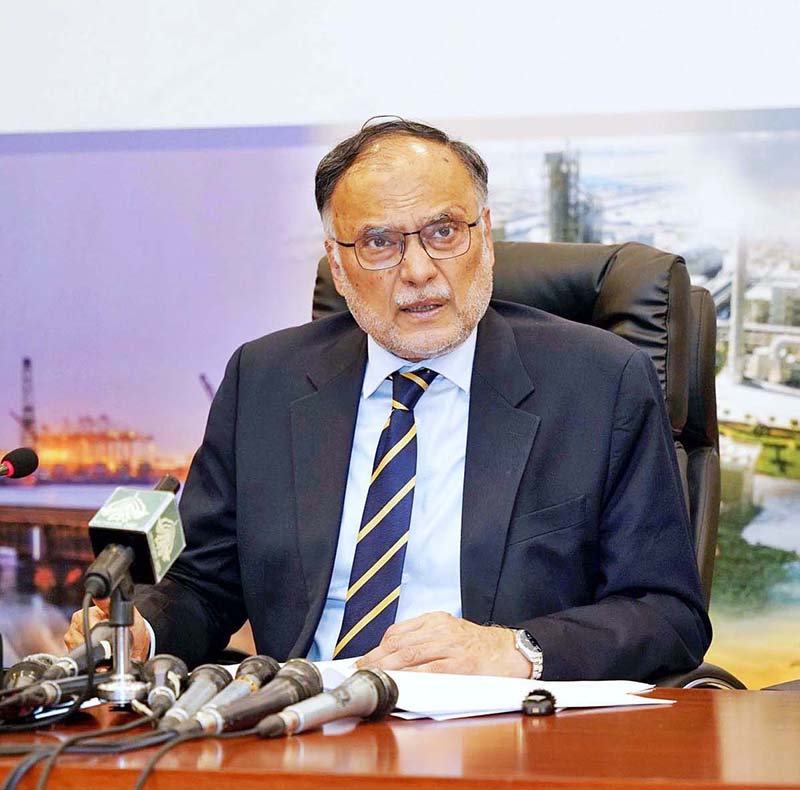
Federal Minister for Planning, Development and Special Initiatives Professor Ahsan Iqbal on Friday urged institutions to rapidly build their capabilities in artificial intelligence (AI) and emerging technologies, saying the country had a historic opportunity to “catch up” with the developed world as AI was set to bring revolutionary changes across every sector of life.
Addressing the 1st International Dental Conference organised by Shaheed Zulfiqar Ali Bhutto Medical University, the minister said the world was undergoing an unprecedented transformation driven by knowledge, innovation, the digital revolution and artificial intelligence, which he described as a change “greater than the invention of the internet.”
“When such a major transformation takes place, it becomes an equaliser,” he said, adding that nations that adapted quickly to new technologies emerged as winners, while those that failed to build new capabilities were left behind.
“This is Pakistan’s opportunity to catch up for the lost time by embracing the new technological era,” he remarked.
Ahsan said AI would reshape education, industry, healthcare and society, stressing that universities across the world were already preparing students for the technological transition.
He said Pakistan’s higher education institutions must also reposition themselves as centres of innovation rather than remaining confined to conventional teaching and research.
Referring to rapid technological advances in dentistry, he said artificial intelligence, regenerative medicine, advanced materials and 3D printing were transforming the profession, making interdisciplinary knowledge indispensable.
“The boundaries between medicine, engineering, data science and artificial intelligence are disappearing,” he said, adding that future dentists would need expertise extending beyond their traditional discipline to succeed in the evolving healthcare landscape.
The minister said universities should focus on applied research that addresses national challenges rather than pursuing publications solely to improve impact factor rankings.
“The National Development Impact Factor is more important than the Impact Factor Journal,” he said, urging researchers to produce innovations that directly improve the lives of the people and contribute to Pakistan’s development.
Highlighting the significance of preventive healthcare, Ahsan described oral health as the foundation of overall human health, saying good dental hygiene played a vital role in protecting major organs and preventing diseases.
He also referred to Islamic teachings that emphasized oral cleanliness and invited the Dental College and the Pakistan Association for Dental Research to formulate a comprehensive national oral health policy, assuring the government would process and implement it on a priority basis.
Recalling the establishment of the university’s dental facilities, Ahsan said he had laid the foundation stone of the project in 2016 with the vision of creating a state-of-the-art institution that would set national standards in dental education.