Karachi
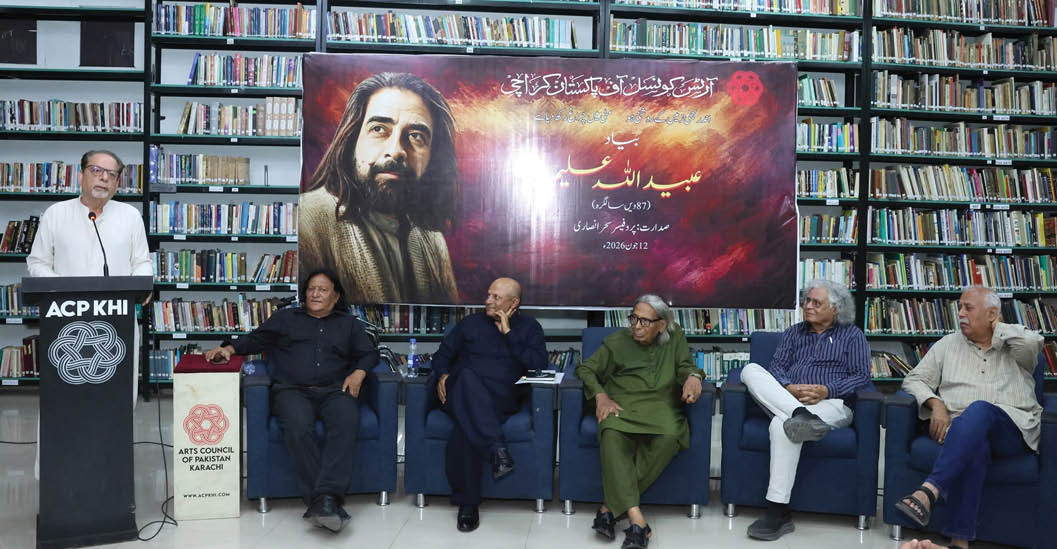
The Arts Council of Pakistan Karachi organized a commemorative event at the Josh Malihabadi Library to mark the 87th birth anniversary of renowned poet Ubaidullah Aleem.
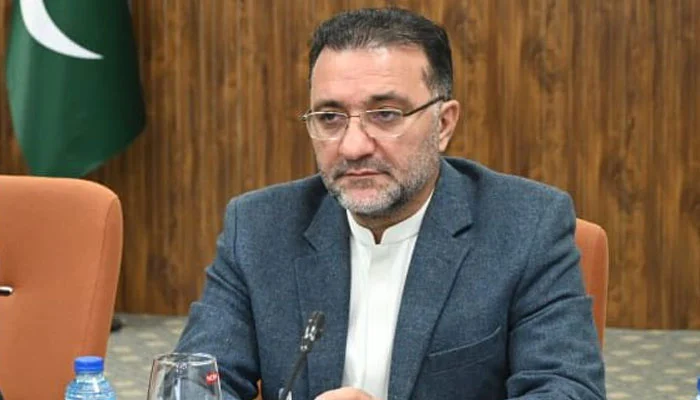
The gathering was attended by President of the Arts Council of Pakistan Karachi, Muhammad Ahmed Shah, while the event was presided over by Prof. Sahar Ansari. Distinguished speakers included Ghazi Salahuddin, Javed Saba, and Wusatullah Khan. Veteran journalist Azhar Abbas captivated the audience with his unique recitation of Aleem’s poetry and ghazals, earning enthusiastic applause from attendees.
A large number of poets, literary figures, and members of civil society were also present. The event was moderated by Shakeel Khan. On this occasion, a birthday cake was also cut in celebration of Ubaidullah Aleem’s 87th birth anniversary.
The ceremony commenced with a Show reel presentation highlighting the literary and artistic contributions of Ubaidullah Aleem, which was warmly appreciated by the audience.
In his presidential address, Prof. Sahar Ansari remarked that although twenty-seven years have passed since Ubaidullah Aleem’s departure, his memories and poetry remain alive and relevant.
He particularly thanked Muhammad Ahmed Shah for consistently ensuring that the legacy of important literary personalities and historical events is preserved and introduced to younger generations.
He noted that Aleem enjoyed immense popularity among young readers and listeners. “He was never a poet of subdued expression,” Ansari said. “He articulated his emotions and convictions with remarkable intensity, which is why he remains one of the most significant and distinctive voices in Urdu poetry.
Future generations will continue to draw inspiration from his work.” He further observed that one of the tragedies of our society is the lack of adequate efforts to preserve the works of its writers and intellectuals.
Speaking on the occasion, Muhammad Ahmed Shah said that love is the fundamental metaphor of poetry and that Ubaidullah Aleem’s ghazals vividly reflect its many dimensions and emotional states.
“Behind every ghazal lies a profound emotional experience or feeling,” he said. “Aleem Sahib was an exceptionally kind and affectionate human being. Unfortunately, he never received the level of publication and recognition he truly deserved.”
Shah added that Ubaidullah Aleem is among those poets who should be celebrated and remembered continuously. “He was a poet of inspiration and emotional waves.
He did not write poetry merely as an exercise in craftsmanship; whenever a surge of feeling arose within him, poetry would naturally flow from his being.”
Renowned journalist, intellectual, and writer Ghazi Salahuddin stated that over the past decade, more work has been done in the field of visual arts than in literature.
He emphasized the need to rediscover Ubaidullah Aleem and reassess his literary significance. “Aleem was among the few Urdu poets who built a unique bridge between tradition and modernity,” he said.
“He was not merely a poet but a sensitive witness to his era. His poetry reflects the social and cultural experiences of Pakistan with remarkable depth. Our society needs poetry now more than ever.”
Journalist and columnist Wusatullah Khan described Aleem as someone who lived poetry rather than merely writing it. “Poetry was an inseparable part of his life,” he said. “Whenever he spoke, he offered fresh ideas, new perspectives, and original arguments.”
Khan recalled the rich literary culture of Karachi in earlier decades, mentioning gatherings at the homes of Qarar Sahib, Saleem Ahmed, and Ubaidullah Aleem, where the doors were always open to writers, intellectuals, and visitors.
“Even if someone arrived late at night, they would be welcomed with accommodation, food, and hospitality without question,” he recalled. “This open-house culture survived until the 1980s but has gradually disappeared.” He added that one of Aleem’s greatest qualities was his generosity toward emerging writers, whom he encouraged and mentored with genuine affection.
Wusatullah Khan also read out a letter written by Aleem’s son, Umair Aleem. Poet Javed Saba remembered Ubaidullah Aleem as an engaging, straightforward, and principled individual.
“He was known for his honesty and clarity of expression,” Saba said. “Particularly when it came to poetry, he was deeply serious and uncompromising in his commitment to literary excellence.