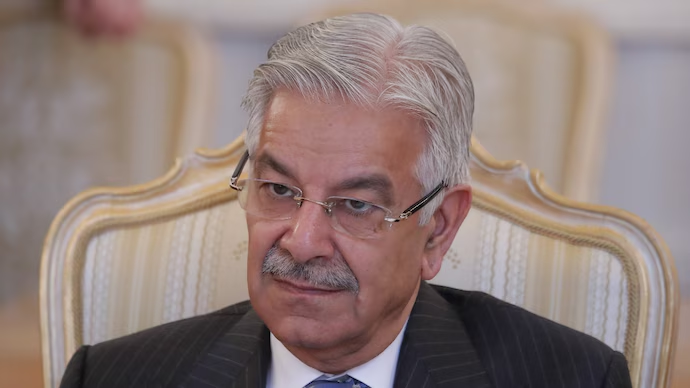
The joint pledge by Pakistan’s Field Marshal Asim Munir and Iran’s General Abdolrahim Mousavi to eradicate terrorism along their 900-kilometre frontier is the first genuine convergence between two neighbours long divided by mistrust, but now united in seeing stability as the currency of prosperity.
By vowing to transform a border scarred by violence into one of “friendship, brotherhood and economic development,” Islamabad and Tehran have begun to situate security within a larger regional vision.
That vision was evident earlier this month when Presidents Asif Ali Zardari and Masoud Pezeshkian announced plans to raise bilateral trade to $10 billion and signed agreements across energy, agriculture, and infrastructure. Both leaders identified terrorism as the primary obstacle to realising this ambition. Prime Minister Shehbaz Sharif captured the new consensus succinctly: a strike in Iran, he said, is felt in Pakistan as deeply as one at home. Security and prosperity are no longer separate conversations; they are indivisible.
The dividends of cooperation could be transformative. Linking Gwadar and Chabahar, once seen as rival ports, could yield a corridor connecting South Asia with Central Asia and the Gulf. Iran’s surplus energy and Pakistan’s persistent demand gap are natural complements. Pakistani textiles and agricultural goods align with Iran’s machinery and energy exports. For both nations, securing the frontier is the key to unlocking these flows. Simply put, there can be no commerce without calm.
This reset must also be read in a wider geopolitical frame. As the Global South recalibrates, BRICS expansion and new trade corridors are challenging Western-led systems. Tehran is already a BRICS member; Islamabad seeks to leverage China’s Belt and Road for broader integration. A stable Pakistan-Iran border can act as a launchpad for these ambitions, positioning both states as pivotal connectors in a reconfigured Asian economic order.
Sceptics caution that closer ties with Tehran could complicate Pakistan’s relations with Gulf partners and the West. Yet Islamabad’s approach is pragmatic. Engagement with Iran is guided by tangible priorities-counter-terrorism, energy, and trade-while maintaining diversified diplomacy elsewhere. For most Pakistanis, the question is straightforward: does this partnership make the homeland safer and more prosperous? Increasingly, the answer is yes.
The challenge now lies in execution. Joint statements must evolve into joint patrols, intelligence sharing, and sustained calm along the border. If Pakistan and Iran succeed, their volatile frontier could become a model of how neighbours turn adversity into opportunity.