Mithi
Mirpurkhas Regional STEAM Festival concluded at Marvi Sports Complex Mithi, with several hundred students from different districts of the region participating organized by the Sindh Education and Literacy Department (SELD), in collaboration with Thar Education Alliance (TEA) on Thursday.
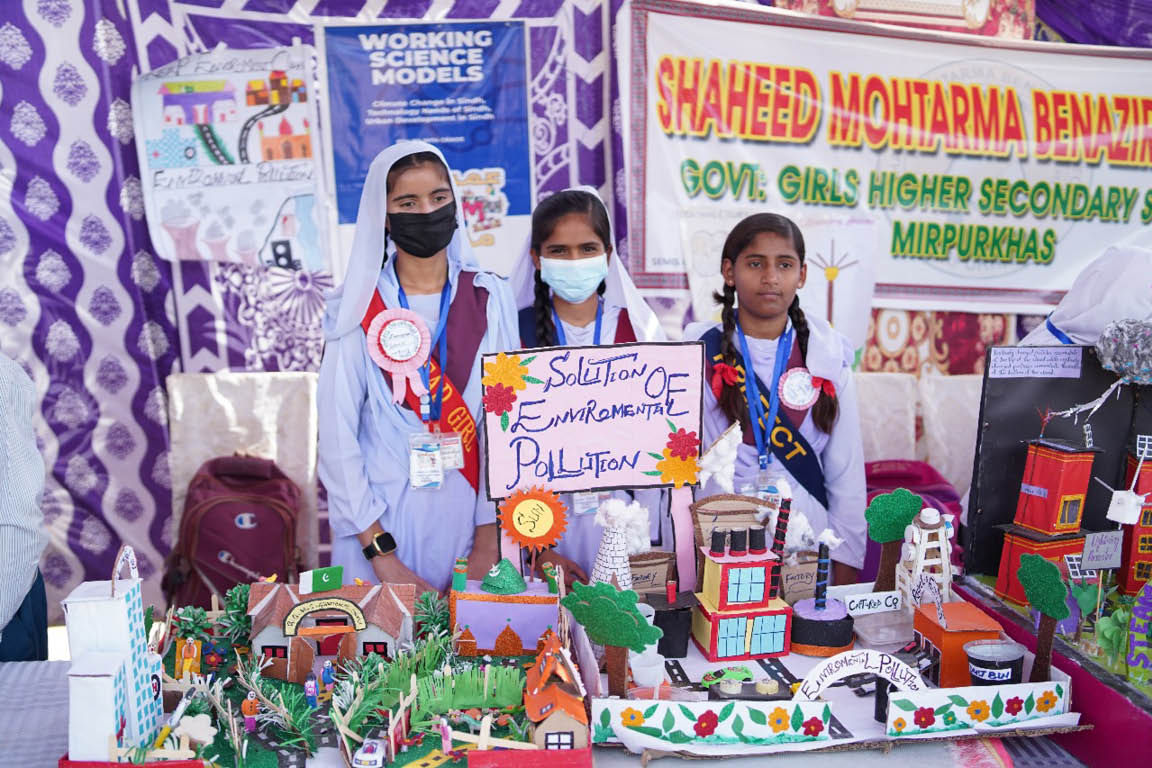
The students, along with their schoolteachers from various districts of Mirpurkhas region, turned up at the venue to participate in the festival, where they exhibited their unique science models, which were keenly watched and praised by visitors.
More than two dozen stalls have been set up in the Mirpurkhas Regional STEAM Festival by students. The students through their scientific models were trying to find sustainable solutions to the challenges being faced by the people. Participants showcased their artistic talent in the Fine Art and Postcard Competitions, while budding scientists brought ideas to life in the Working Science Model Competition. Educators take on the Teacher Game Challenge to create interactive learning experiences. The Musical Instrument Engineering category inspired the invention of unique instruments, while Pakistan in 2100 invited bold visions of the future.
Pakistan People’s Party, MNA and Federal Parliamentary Secretary for Health Services, Dr Mahesh Kumar Malani, Director of Colleges Sindh, Dr. Naveed Rab Siddiqui, Director of Secondary Education Mirpurkhas, Iqbal Kanbhar, Chief of Thar Education Alliance, and officials from education department and different walks of life inaugurated the festival.
After formally inaugurating the festival PPP MNA Dr. Mahesh Kumar Malani said that the transformative impact of the Thar Science Festival, an initiative launched by the Thar Education Alliance in 2018. In just a few years, this initiative has set a powerful trend in Sindh, with Mirpurkhas, Tharparkar, and Umerkot emerging as leading regions in education.
Dr. Malani added that the talent of the students speaks for itself, as reflected in their outstanding MDCAT results. He stressed the importance of providing opportunities for young minds, asserting that when given the right platform, children eagerly showcase their potential.
He also stressed that the urgent need to focus on girls’ education, stating that a prosperous society is only possible when female literacy rates rise significantly. “Educating a girl means educating a generation,” he remarked, urging collective efforts to ensure that every child, especially girls, has access to quality education. Girls out of school in rural areas should be brought back to school, and measures will be taken for this purpose. The Sindh Education Minister is also making efforts to reopen closed schools, and SEMIS codes will be assigned to schools.
Next week, meetings will be held with education officers and institutions to devise a special strategy for girls’ education. The Sindh government has taken practical steps in the education sector, appointing a large number of teachers. A cluster policy is now being formulated, and school monitoring is being improved.
Director of Colleges Sindh, Dr. Naveed Rab Siddiqui said that the Sindh Education and Literacy Department is setting an example in the province by fostering an environment for STEAM education. This visionary initiative, led by our esteemed minister and dedicated educationists, is creating opportunities for collaboration and innovation. This platform allows individuals to learn from one another, encouraging the exchange of ideas and collective growth. “If someone introduces a new idea and we witness its potential, let us cultivate a culture of acceptance and support. Together, we pledge to continue our efforts to enhance education. Now is the time to showcase our talents at the provincial, national, and international levels.” He said.
In a panel discussion on “Breaking Barriers: Empowering Girls in STEAM Education,” Kanchan Kumari, a dedicated teacher, shared her insights on the evolving perception of STEAM among students. She noted that, initially, many students believed STEAM was solely focused on science, unaware of the diverse disciplines it encompasses. However, through active participation—from school-level competitions to district and now regional platforms—they are continuously learning, expanding their knowledge, and discovering new opportunities.
She emphasized that STEAM is not just for so-called “genius” students; every individual is brimming with creativity and ideas. By fostering an inclusive and supportive environment, we can unlock the potential of every young mind, empowering them to innovate and lead in the fields of science, technology, engineering, arts, and mathematics.
During the panel discussion, Kalpna Kothari highlighted a critical issue in many schools: the lack of resources and laboratory materials. She also pointed out that, in some cases, teachers do not actively engage students in hands-on learning experiences.
As a physics teacher and a specialist in the subject, she said that the importance of making learning possible, regardless of limitations. She encouraged collaboration between schools, suggesting that those with well-equipped labs can support others that lack resources. By fostering a spirit of curiosity and teamwork, she believes that every student can have the opportunity to explore and experience the wonders of physics firsthand.
The event concluded with a prize distribution ceremony, recognizing the winners for their outstanding achievements.