ISLAMABAD
Leading policymakers, and regional experts convened for an online seminar hosted by the Central Asia Program for Regional Cooperation and Connectivity at the Institute of Regional Studies, Islamabad as part of its Eminent Speaker Series titled “Breaking the Connectivity Barrier to Central Asia: Pakistan and the C5 in 2026.”
Experts from Russia and Uzbekistan underscored the urgent need to transform visions into tangible action to advance Eurasian connectivity. While connectivity has long been a strategic aspiration, tangible progress hinges on implementation, coordination, and political will. President of the Institute of Regional Studies, Ambassador Jauhar Saleem inaugurated the session by framing connectivity as a “multidimensional agenda” central to regional stability and prosperity.
He noted that despite shared ambitions—mirroring similar regional visions on Eurasia as those pursued by Türkiye—Pakistan’s connectivity with Central Asia remains below its potential.
He identified several persistent barriers including critical infrastructure gaps, instability in Afghanistan, regulatory and customs fragmentation and logistical bottlenecks as impediments which need to be overcome for rhetorical commitments to translate into practical, implementable solutions for regional integration.
Policy Analyst and Expert of the Valdai Discussion Club and the Gorchakov Fund from Russia, Dr. Daria Saprynskaya highlighted that connectivity, from a Russian perspective, encompasses trade, logistics, investment, and security, all of which are deeply interlinked.
She outlined Russia’s evolving strategic vision centered on the concept of “integration of integrations,” linking major regional initiatives such as the Eurasian Economic Union (EAEU) and China’s Belt and Road Initiative (BRI) to build a flexible and interconnected Eurasian architecture rather than a single unified bloc.
Connectivity hence, operates on two inseparable dimensions: economic (infrastructure, trade corridors) and political-institutional (regulatory and multilateral frameworks) with Central Asia serving as a critical bridge, linking Russia with South Asia, the Middle East, and beyond.
Dr. Saprynskaya also noted that while all projects contribute to regional development, some could reshape geopolitical balances.
Leading Research Fellow at the International Institute for Central Asia (IICA) in Tashkent and former Leading Specialist at Uzspace, Mr. Salomov Bakhtiyor Ravshan o’g’li emphasized on how connectivity is not a zero-sum game, but a shared platform for mutual economic gain.
Highlighting impressive growth in Uzbekistan–Pakistan trade—from $36 million in 2017 to over $400 million in 2024—he spoke of vast, untapped potential, with bilateral trade projected to reach $2 billion in the coming years.
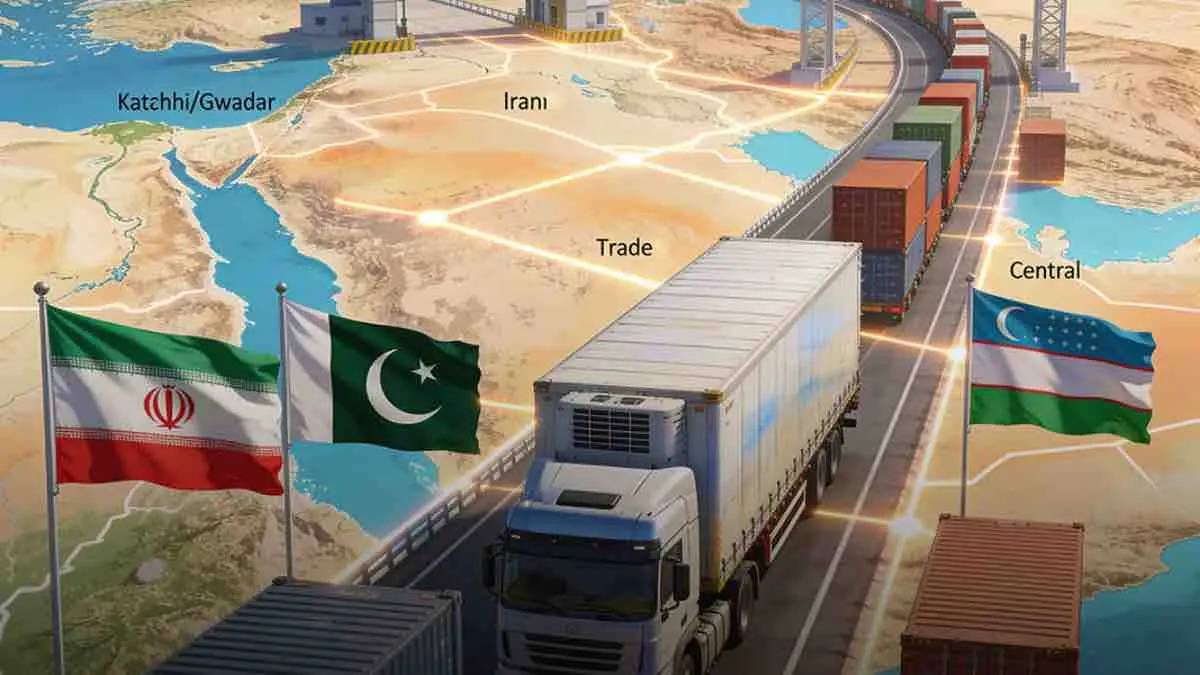
Lowering transportation costs through improved infrastructure, ensuring maritime access for landlocked Central Asian states, digitalizing customs and transit systems and addressing persistent security concerns, allows Pakistan to become a strategically vital partner capable of linking Central Asia to global markets.Expert on Asian Affairs at the Institute of China and Contemporary Asia at the Russian Academyof Sciences in Moscow Dr. Liudmila A.
Pechishcheva underlined the growing diversification of connectivity options for Central Asia, particularly Uzbekistan’s efforts to expand access through both land and maritime routes. She underscored Pakistan’s increasing importance as a regional transit hub, noting that Karachi and Gwadar ports serve as key gateways for Central Asian trade with emerging railroad integration linking Central Asia with Pakistan’s transport network.
The potential from data and energy transit corridors connecting Central Asia to the Middle East and Europe, operationalization of energy pipelines and the expansion of corridor networks further places Pakistan’s at the heart of strategic geographic positioning in a rapidly evolving Eurasian connectivity landscape.
The session concluded with a strong consensus among all experts that Eurasian connectivity is no longer a theoretical ambition but an urgent strategic necessity. While political visions and regional frameworks are in place, the next phase requires execution, coordination, and sustained investments.