Haroon Siraj
SWAT
For a child in trouble, help does not always begin at a police station or a government office. Sometimes it begins with a conversation between two women in a neighbourhood, a girl confiding in another girl, or a religious leader speaking to a family before a decision puts a child at risk.
In Swat, such community level interventions are now being brought into a formal child protection structure, as women, adolescents, faith leaders and other community members are being enlisted to identify children at risk, report concerns and connect vulnerable families with protection services.
In one neighbourhood at Amankot area of Swat, a boy had stopped going to school because his family could no longer afford the fees. His mother did not approach a government office. She spoke to a woman who was part of a newly formed community child protection committee.
The committee president contacted the Child Protection Unit, which intervened with the school administration. According to the committee president, half of the outstanding fee was paid and the boy returned to school.
The case illustrates the idea behind a new community based child protection system taking shape in Swat, where women, adolescents, faith leaders and other community members are being brought into the formal protection network.
Swat has established 21 Child Protection Committees with 315 members, according to data provided by the Child Protection Unit. Each committee has 15 members, including three adolescent or child members, while the inclusion of a faith leader is mandatory.
The committees were established under Section 10-F of the Child Protection and Welfare Act 2010 to expand the outreach of the Child Protection Unit, improve access to reporting mechanisms and engage communities in protecting children at risk.
But their significance extends beyond the creation of another institutional structure. The initiative is placing people who influence children’s lives every day, including mothers, fathers, religious leaders, adolescents and community elders, closer to the child protection process.
A substantial protection challenge
The scale of cases reaching the Child Protection Unit highlights the need for stronger protection mechanisms at community level.
According to CPU data, 503 child protection cases were registered in Swat between 2022 and 2026. These included cases involving exploitation and child begging, sexual abuse, neglect, missing or runaway children, physical violence and corporal punishment, abandonment and juvenile cases.
Exploitation and child begging accounted for 289 cases, involving 200 boys and 89 girls. The unit also recorded 62 sexual abuse cases involving 51 boys and 11 girls, while 48 cases involved neglect.
In 2026 alone, the CPU recorded 71 cases involving 58 boys and 13 girls. These included 21 sexual abuse cases, four cases of corporal punishment, one case of physical violence, four custody or neglect cases and 41 exploitation or child begging cases.
The figures represent cases that reached the protection system and should not be interpreted as a measure of the overall prevalence of child protection violations in the valley.
For girls in particular, under reporting remains a concern where stigma, family pressure, lack of awareness or limited access to services can discourage children and families from seeking help.
The committees are intended to help close some of that gap.
Taking protection closer to families
Child Protection Officer Ihsan Khan said the committees were created to expand the CPU’s outreach and make it easier for communities to report cases involving children at risk.
According to Ihsan Khan, roughly 25 to 30 percent of the cases reported to the CPU in 2026 were referred through the community based committees.
Committee members have received training on identifying children at risk, reporting and referring cases, coordinating with the CPU and guiding families towards available protection services.
Their responsibilities also include raising awareness about exploitation, violence, neglect and abuse within their communities.
The committees currently operate in 21 areas and are planned to be expanded to every Village Council and Neighbourhood Council.
Letting girls speak for themselves
The inclusion of adolescents gives the initiative another dimension. Children are not only being treated as recipients of protection but are also being given a place within a community-level structure.
An adolescent member of one of the committees, whose identity is withheld for her protection, said she joined because she wanted to contribute to the rights of women and children.
Women creating a local entry point
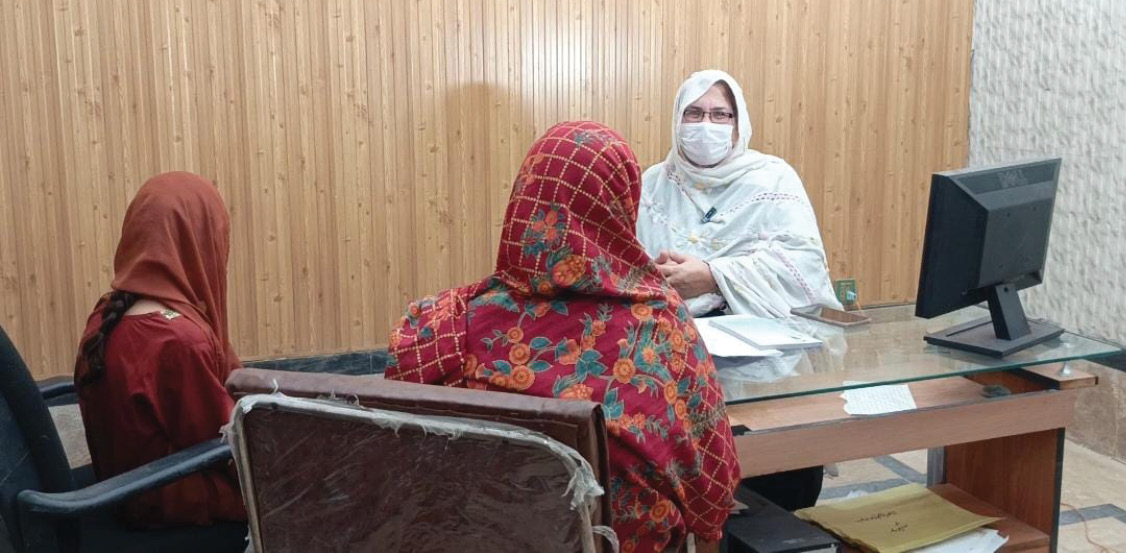
Asmania, President of a female Child Protection Committee in Amankot, the biggest change has been that women now have a local platform through which they can raise concerns.
She began holding meetings with women and girls in her neighbourhood and encouraged them to report cases involving children being sent to beg or collect garbage instead of attending school, early marriages and abuse.
The school fee case was one of the first matters brought to her committee.
She also recalled an incident involving a woman who sought help arranging dowry items for a teenage girl. When Asmania learned that the girl was under 18, she warned the woman about the legal implications of arranging such a marriage.
According to Asmania, women in her area were previously unfamiliar with police stations, courts, lawyers and child protection offices and were often hesitant to approach formal institutions.
The committee, she said, has given women greater confidence to speak about problems and seek help.
The value of such a mechanism lies partly in accessibility. A protection system can only work when families know where to turn and feel sufficiently confident to make the first approach.
Faith leaders challenge harmful practices
The initiative has also sought to bring religious leaders into efforts to change social norms.
The CPU says more than 30 faith leaders have been engaged through discussions and awareness activities on early marriage in collaboration with Islamic Relief Pakistan.
The aim is to use trusted community figures to challenge harmful practices and promote children’s rights through religious and social dialogue.
Maulana Shakir, an imam and member of a Child Protection Committee in Saidu Sharif, said he uses Friday and Eid sermons and other religious gatherings to discuss early marriage and child protection.
He also speaks to fellow religious scholars and madrassa students about the importance of ensuring that marriages comply with legal requirements and protect children’s rights.
His involvement has also extended beyond awareness sessions.
He recalled an incident in which boys were teasing adolescent girls on their way to school. He identified the boys and called their parents, warning them that continued behaviour could result in formal action through the child protection system.
In another case, he said, an under-18 girl whose parents had died approached him because her uncle was considering arranging her marriage.
According to Maulana Shakir, he spoke with the uncle, who agreed to wait until the girl reached the appropriate age and to take her consent into account.
Such individual interventions cannot by themselves prove a wider change in community behaviour. They do, however, show how influential figures can use their position to intervene before a harmful practice develops into a formal child protection case.
Changing the attitudes around children
Women and child rights activist and Khwendo Jirga founder Tabassum Adnan, sustainable change cannot be achieved by empowering women alone.
She argues that men and boys, faith leaders, families, elders and other influential members of society must become partners in changing attitudes towards girls’ education, early marriage, women’s participation in decision making and gender discrimination.
Men and boys, she said, should be viewed as partners and champions of change rather than opponents of women’s rights.
Her argument reflects the broader purpose of the community committee model. Harmful social norms are formed and reinforced within families and communities, meaning that changing them also requires the participation of those who hold influence within those communities.
From awareness to prevention
The CPU says committee members have received two-day training on child protection systems and their roles and responsibilities.
The unit has also trained 60 government and non-government officials on child protection systems and relevant laws.
During 2025-26, awareness activities on child protection and rights reached 200 children and other stakeholders, while psychosocial support and hygiene kits were provided to 600 children affected by floods.
These figures indicate an expanding network of community engagement.
The more difficult task is measuring whether that engagement is changing behaviour.
The number of committees, trained members and awareness sessions demonstrates reach, but it does not by itself establish that harmful social norms are changing.
That will require continued evidence of outcomes, including whether more girls remain in school, whether early marriages are prevented, whether children can report concerns safely, whether boys challenge harmful behaviour and whether community interventions prevent cases from reaching the formal protection system.
For now, Swat’s community based approach is creating a new layer of protection around children.
Its success will ultimately depend not on the number of committees established, but on whether a child who once had nowhere to turn now knows whom to approach and whether the adults around that child are willing to listen, intervene and act.