ISLAMABAD
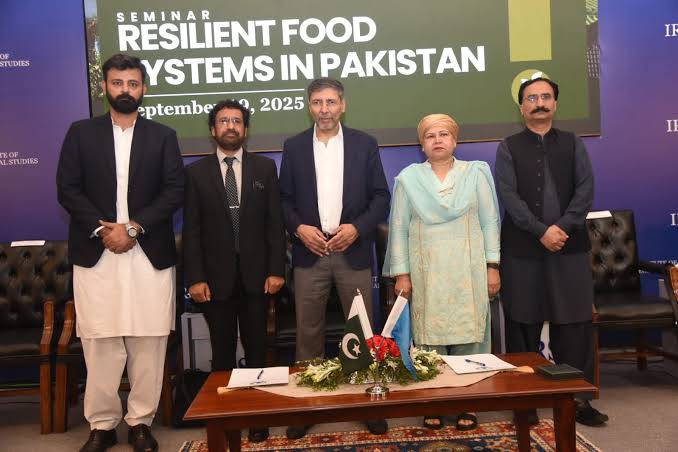
The Institute of Regional Studies (IRS), Islamabad, organized a seminar titled “Harvesting Hunger: A Looming Food Crisis in Pakistan” to assess the growing risks of food insecurity in the country, driven by fertilizer shortages and ongoing geopolitical instability in the region.
Ambassador Jauhar Saleem, President IRS, cautioned that the global community is not paying adequate attention to the rapidly intensifying food crisis.
He highlighted the strategic importance of the Gulf region, noting that it accounts for 30–35% of global urea trade, while nearly 30% of the world’s fertilizer trade passes through the Strait of Hormuz, making it a critical chokepoint with far-reaching implications for global food supply chains.
Ms. Isabel Bogorinsky, Welthungerhilfe (WHH) Head of Program in Pakistan, emphasized the vital role of international non-governmental organizations in strengthening food security in Pakistan. She noted that WHH, established in 1962, is one of Germany’s largest private non-profit aid organizations and is currently operating in over 22 districts across Pakistan.
She outlined the organization’s approach, which focuses on enhancing community resilience and transforming food systems rather than relying on short-term interventions. In 2025 alone, WHH reached approximately 4.72 million people through its initiatives.
Mr. Omer Bangash, Food and Nutrition Security Advisor at WHH, presented key findings from the Global Hunger Index 2025, under which Pakistan ranks 106th out of 123 countries with a score of 26.0, indicating a “serious” level of hunger.
He further shared that the IPC Technical Working Group assessed that in 2025, around 11 million people in Pakistan faced acute food insecurity, including 1.7 million in IPC Phase 4, representing extreme levels of crisis.
Projections for 2026 indicate a sharp escalation, with up to 20 million people expected to face acute food insecurity and malnutrition between April and September.
Moderating the session, Mr. Talha Tufail Bhatti, Lead Climate Governance, Policy and Food Security Program at IRS, underscored that Pakistan is entering its 2026 heatwave season, warning that “extreme heat” is emerging as a critical risk multiplier.
He stressed the need for a whole-of-society approach to effectively address the intensifying climate crisis and its cascading impacts on food security.