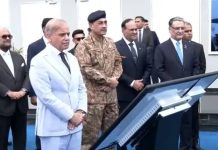
‘Decision taken in light of Court of Inquiry’s recommendations’
DLP REPORT
RAWALPINDI
Pakistan’s military said on Tuesday that officials of the Inter-Services Intelligence (ISI) and Pakistan Rangers, Sindh, involved in the “Karachi incident” which preceded the arrest of former PM Nawaz Sharif’s son-in-law Captain (retired) Muhammad Safdar on the morning of October 19 in the port city, have been removed.
Safdar’s arrest had occurred when he was staying with his wife Maryam Nawaz in a hotel room after attending a public rally of the Pakistan Democratic Movement, an anti-government alliance of opposition parties. The reason cited for his arrest was raising slogans at the mausoleum of Mohammad Ali Jinnah. Following the arrest, Maryam, Sindh government, and opposition leaders claimed that the Sindh police chief was kidnapped and kept hostage for four hours at the office of the sector commander of the ISI and forced to register an FIR after he refused to take any action against Sharif’s son-in-law.
The Army Chief General Qamar Javed Bajwa took notice of the incident and ordered an immediate inquiry after the Pakistan Peoples Party (PPP) Chairperson Bilawal Bhutto-Zardari called on him to investigate the circumstances surrounding Safdar’s arrest.
A Court of Inquiry established on the orders of Gen Bajwa to probe the alleged abduction and pressuring of Sindh’s police chief has found officers of Pakistan Rangers and the ISI to have created an “unwarranted situation”.
A statement issued by the Inter-Services Public Relations (ISPR), army’s media arm, supported the allegations forwarded by the Sindh government and opposition leaders that Sindh Inspector General of Police Mushtaq Maher was ‘abducted’ by officials of the ISI and rangers and pressured into issuing arrest orders for the Pakistan Muslim League (Nawaz) leader.
“The Court of Inquiry has established that on the night of October 18/19, officers from Pakistan Rangers (Sindh) and ISI sector Headquarters Karachi were considerably seized with the fallout of the desecration of Mazar-e-Quaid,” the ISPR statement said. “They were under increasing public pressure to ensure prompt action as per the law. Assessing the response of police authorities against this developing yet volatile situation to be slow and wanting, in a charged environment, the concerned officers decided to act, rather over-zealously,” the statement read, without clarifying what “public pressure” the ISI and paramilitary force were under.
“They were indeed experienced enough to have acted more prudently and could have avoided creating an unwarranted situation that led to misunderstanding between the two state institutions,” it said. “Based on the recommendations of the Court of Inquiry, it has been decided to remove the concerned officers from their current assignments for further departmental proceedings and disposal at GHQ,” it said.
The statement avoided identifying the officers who were involved in the Karachi incident and merely assured the public that they will face further departmental action.