Islamabad
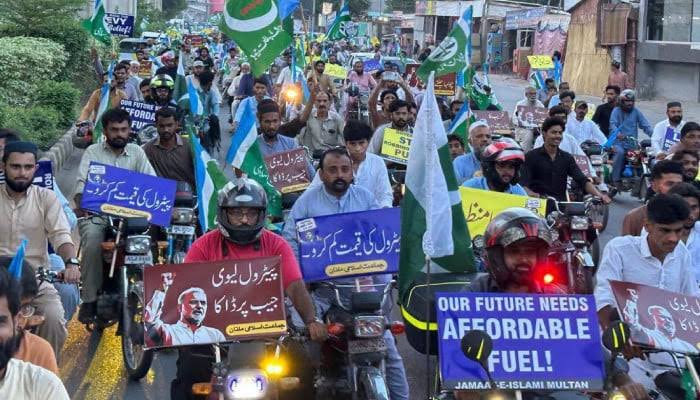
Jamaat-e-Islami (JI) held protest demonstrations across Northern Punjab on the call of party chief Hafiz Naeem-ur-Rehman, demanding a substantial reduction in petroleum prices and the immediate abolition of the petroleum levy. Demonstrations were held in Rawalpindi, Gujrat, Mandi Bahauddin, Talagang, Murree, Khushab, Chakwal, Jhelum, Attock, Mianwali and Sargodha. JI Punjab Emir Dr. Tariq Saleem led the protest in Gujrat, while Punjab Secretary General Iqbal Khan led the demonstration in Attock. Other provincial and district leaders also addressed the protesters.
Speaking in Gujrat, Dr. Tariq Saleem said the third phase of JI’s nationwide protest movement against the petroleum levy had begun under the directives of Hafiz Naeem-ur-Rehman. He said the relief package announced after the party’s protests was insufficient and had failed to provide meaningful relief to the public. He said inflation had placed a severe burden on ordinary citizens and described the petroleum levy as an “extortion tax.” He also criticised payments to Independent Power Producers (IPPs), alleging that billions of rupees were being paid even for electricity that was not generated. Dr. Tariq Saleem said JI protests and sit-ins were taking place simultaneously in 150 cities across the country.
He warned that if the government continued to delay negotiations and failed to provide substantial relief, the party would intensify its campaign. He reiterated that abolishing the petroleum levy was a non-negotiable demand and said JI would march towards Islamabad if the government did not accept it.
Addressing protesters in Attock, Iqbal Khan said the government should withdraw the petroleum levy of Rs80 per litre on petrol, the Rs5 climate support levy and other taxes. He warned that a large number of people could march to the federal capital if the demands were not met. Khan said peaceful protest was a constitutional and democratic right and urged party workers to intensify preparations for the planned march to Islamabad. He said the government should not create obstacles to the party’s peaceful political campaign.
He further argued that falling international petroleum prices had not translated into adequate relief for Pakistani consumers. Although the government had reduced prices slightly following JI’s protests, he said the reduction was insufficient and called for petrol to be priced at Rs225 per litre.
Iqbal Khan also demanded reductions in electricity and gas tariffs. He criticised the government for citing pressure from the International Monetary Fund (IMF) to justify measures affecting the public, while, he alleged, failing to make comparable cuts to official expenditure and the privileges enjoyed by the ruling elite. Both leaders reiterated that Jamaat-e-Islami would continue its peaceful protest movement until the government addressed its demands for lower petroleum prices, the abolition of the levy and relief from rising energy costs.