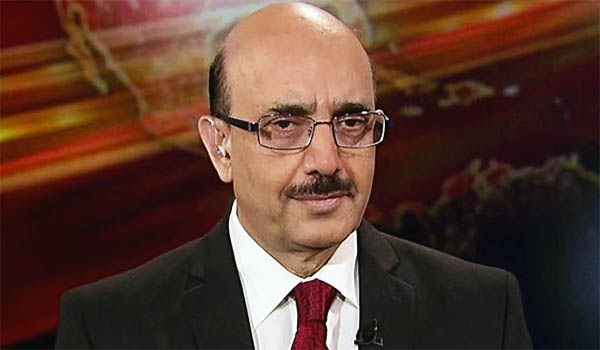
The Kashmir dispute must be resolved in accordance with United Nations Security Council resolutions to ensure the right to self-determination of the Kashmiri people, said Sardar Masood Khan, former ambassador of Pakistan to the United States, China and the United Nations, and former president of Azad Jammu and Kashmir.
According to a press release issued here Wednesday, Khan was addressing a seminar organised by the Institute of Kashmir Studies at the University of Azad Jammu and Kashmir on Kashmir Black Day, observed on October 27.
He highlighted the historical background of the conflict, the aspirations of the Kashmiri people and the continuing need for a peaceful and just settlement.
Khan recalled that October 27, 1947, marked the arrival of Indian forces in Jammu and Kashmir, fundamentally altering the course of the region’s history. Referring to the political developments surrounding Partition, he said that the Muslim-majority population of Jammu and Kashmir had strong aspirations regarding its future, while the promise of a plebiscite under the United Nations framework remained unfulfilled.
He emphasised the importance of examining historical records and challenging misleading narratives surrounding the origins of the conflict. He also referred to the violence and displacement experienced by Muslims in Jammu in 1947, stressing that the human cost of the dispute must remain central to any understanding of Kashmir’s history.
He said the situation following India’s unilateral actions of August 5, 2019, had further intensified concerns about the political rights and freedoms of the Kashmiri people. He underscored that the conflict could not be set aside or treated as a secondary issue, particularly given its implications for regional stability.
Referring to the military escalation between Pakistan and India in 2025, he warned that the unresolved dispute carried the risk of renewed confrontation between two nuclear-armed neighbours.
He stressed that sustainable peace required addressing the underlying causes of tensions rather than relying on temporary arrangements.
Khan also urged students and academics to study Kashmir’s history critically, strengthen their intellectual capacity and counter misinformation through informed debate.
He emphasised that higher education was indispensable for Pakistan’s progress and for effectively advocating the Kashmiri people’s right to self-determination.
He said Pakistan remained committed to the implementation of relevant United Nations resolutions and that a durable regional peace could not be achieved while this dispute remained unresolved.