DLP Report
PESHAWAR
Chief Minister Muhammad Sohail Afridi on Saturday said Khyber Pakhtunkhwa had borne the brunt of flawed security policies for decades and should no longer be used as a “testing ground” for experiments that put the lives and livelihoods of its people at risk.
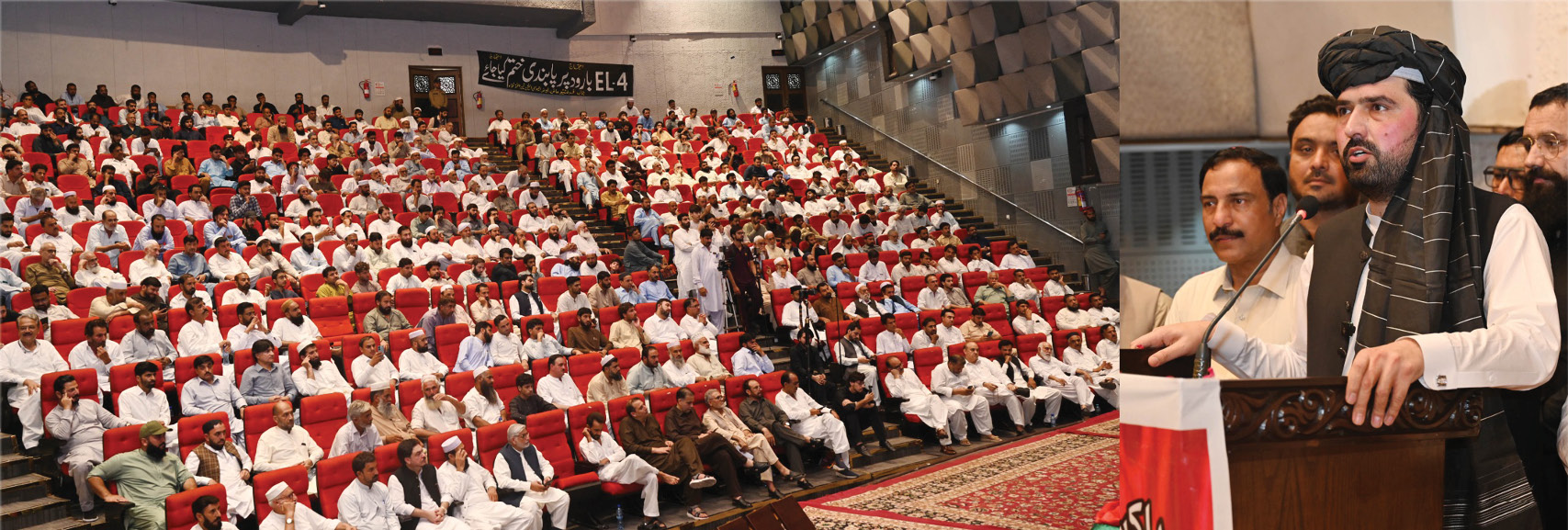
Addressing a traders’ convention organised by the Pakistan Tehreek-i-Insaf (PTI) Traders Wing at Nishtar Hall, Peshawar, the chief minister said the province had suffered disproportionately from the consequences of the country’s participation in the United States-led war on terror, claiming that the decision had not been made in Pakistan’s national interest.
Paying tribute to the people of Khyber Pakhtunkhwa and the country’s security forces, he said around 80,000 people had lost their lives in the fight against terrorism to restore peace.
Mr Afridi alleged that terrorism resurged after the removal of the PTI government led by Imran Khan, claiming his party had repeatedly warned that militants were regrouping but its concerns had been dismissed. He said renewed violence had not only claimed lives but also damaged businesses and economic activity, particularly affecting the trading community.
He said no individual or group should be allowed to pursue personal or financial interests at the expense of the people of Khyber Pakhtunkhwa, adding that the province could no longer be treated as expendable.
Referring to the prevailing security situation, the chief minister said the challenges facing Khyber Pakhtunkhwa had intensified and similar conditions had emerged in Balochistan. He also expressed concern over the situation in Jammu and Kashmir, reiterating Pakistan’s longstanding position on the dispute.
Mr Afridi argued that military force alone could not ensure lasting peace, saying more than two decades of counterterrorism operations had demonstrated the need for a broader approach. He questioned why the country’s governance system had failed to deliver long-term stability despite decades of experience.
Recalling the PTI government’s tenure, he claimed Pakistan’s economy had shown positive growth under former prime minister Imran Khan despite the Covid-19 pandemic, with traders, farmers and young people benefiting from improved economic conditions.
The chief minister said all state institutions should operate within their constitutional limits, arguing that governance suffered when institutions exceeded their mandates.
He also maintained that only Imran Khan had the public support and leadership capacity to steer the country out of its current political and economic challenges, adding that the use of force against peaceful protesters could not provide a lasting solution to political disputes.