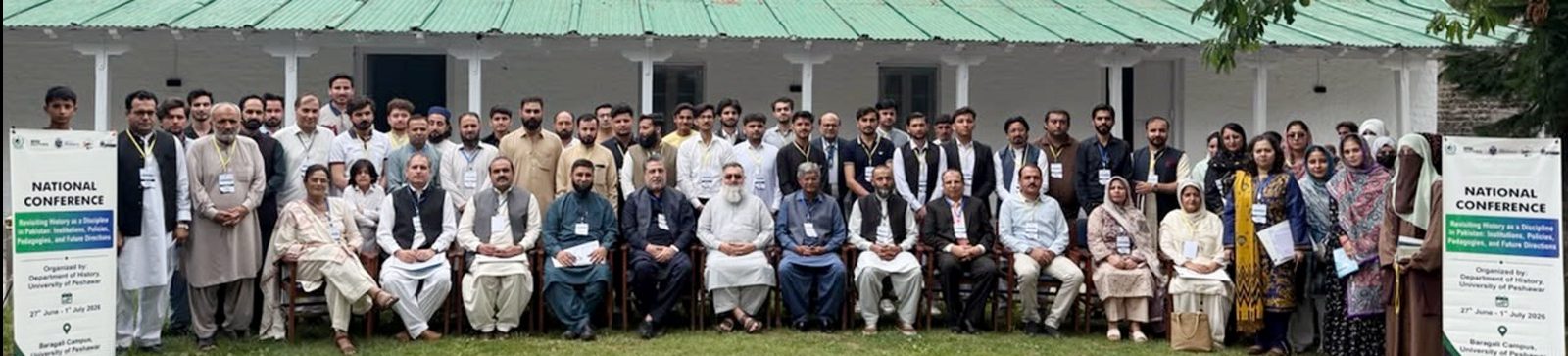
BARA GALI: A five-day national conference titled “Revisiting History as a Discipline in Pakistan: Institutions, Policies, Pedagogies, and Future Directions” concluded at the Bara Gali Summer Camp of the University of Peshawar on July 1. Organised by the Department of History, the conference brought together scholars, teachers, researchers, and students from across Pakistan to deliberate on the future of historical studies in the country.
The inaugural session was chaired by Prof. Yorid Ahsan Zia, Registrar, University of Peshawar, who attended as Chief Guest on behalf of Vice Chancellor Prof. Dr. Johar Ali. Conference Chair Dr. Altaf Qadir welcomed participants and highlighted the need for critical reflection on the discipline of history and its future challenges.
Delivering the keynote address, Prof. Dr. Muhammad Shafique discussed the conceptual and methodological challenges facing historical scholarship in Pakistan. He urged historians to strengthen the discipline’s own research methods and emphasised that Artificial Intelligence should be understood and used responsibly rather than viewed as a threat.
Over two days of academic sessions, researchers presented papers on curriculum, pedagogy, archives, public history, digital technologies, decolonial perspectives, cultural heritage, regional histories, and employment opportunities for history graduates. The sessions featured lively discussions and scholarly exchanges.
A round-table discussion on “The State of the Discipline of History” focused on institutional, curricular, archival, and professional challenges. Participants agreed to establish an Association of Pakistani Historians to provide a collective platform for historians and strengthen engagement with academic and policy-making institutions.
During the concluding session, conference proceedings and recommendations were presented, while participants also proposed holding a second conference on the same theme in collaboration with another host institution.
Chairing the closing session, Prof. Dr. Husnul Amin praised the academic quality and organisation of the event, describing it as one of the finest academic conferences he had attended in Pakistan.
The conference concluded with a cultural programme and a recreational excursion to Mushkpuri Top, Lalazar, and Ayubia, before participants departed on July 1 with a renewed commitment to advancing the discipline of history in Pakistan.