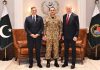
Pak-US relations have been back on track after a long spell of acrimony coming in the wake of President Trump’s tweets at the start of the year in which he seemed nullifying Pakistan so far efforts in the war against terrorism and which prompted the incumbent government to deliver a message unequivocally with all stakeholders on the same page to the United States (US) that Pakistan wanted an acknowledgement for their stand by the US instead of being fed mantra of “Do More”. The recent thaw in the bitter relationship has been prompted by the recently sent letter on the part of the US President Trump, seeking Pakistan’s support in finding a solution to Afghanistan conundrum through negotiations.
As Pakistan aided US-Taliban talks are set to kick off on Monday and it is hoped that the joint overture for stability gets pace this time as an instability in Afghanistan has been turning out to be a bane for the whole region in almost every aspect-be it socially, politically and economically- it is worth reflecting on Pak-US relations at this moment in the light of history to find out patterns in the bonhomie between the super power, the US, and client state, Pakistan, for variation of interests dictated political expediency, resulting in a fair-weather friendship between the two states and giving birth to a lot of distrust. It’s important to bring into spotlight the pitfalls of Pak-US relations in the light of history as mistakes of the past are likely to surface again in the upcoming talks if they are not heeded to and may turn the seemingly proximity into a bitter relationship.
Going back to early years of Pakistan’s existence, Pak-US relations did not develop because of mutuality of interests rather they were informed by political expediency. Pakistan early overtures towards the US reflective from Prime Minister Liaqat Ali Khan’s visit to the US and later on signing of the pacts like SEATO and CENTO- in the wake of which Pakistan received a lot of military assistance and expertise- were predominantly informed to fend off the security threat emanating from the eastern border, India. On the other hand, the US generosity towards Pakistan with respect to economic and military assistance in early years was aimed at another interest that was to make it capable enough to stand against communist threat, which was in retrospection not a substantial threat to Pakistan, and perhaps to enlist Pakistan in the capitalist block to impress upon the Soviets its widening influence across the globe.
Thus, Pak-US relations without mutuality of substantial interests backfired after a first decade due to the US increasing overtures towards India and also because of Pakistan invoking wrath of the Soviet Union after a US spy plane that had taken off from military airbase in Peshawar was shot down by the Soviets. As a result what we see in General Ayub’s era is that Pak seemed neutral vis-à-vis its foreign policy by making overtures towards beacons of then communist bloc in the likes of China and Soviet Union instead of confining itself to capitalist bloc.