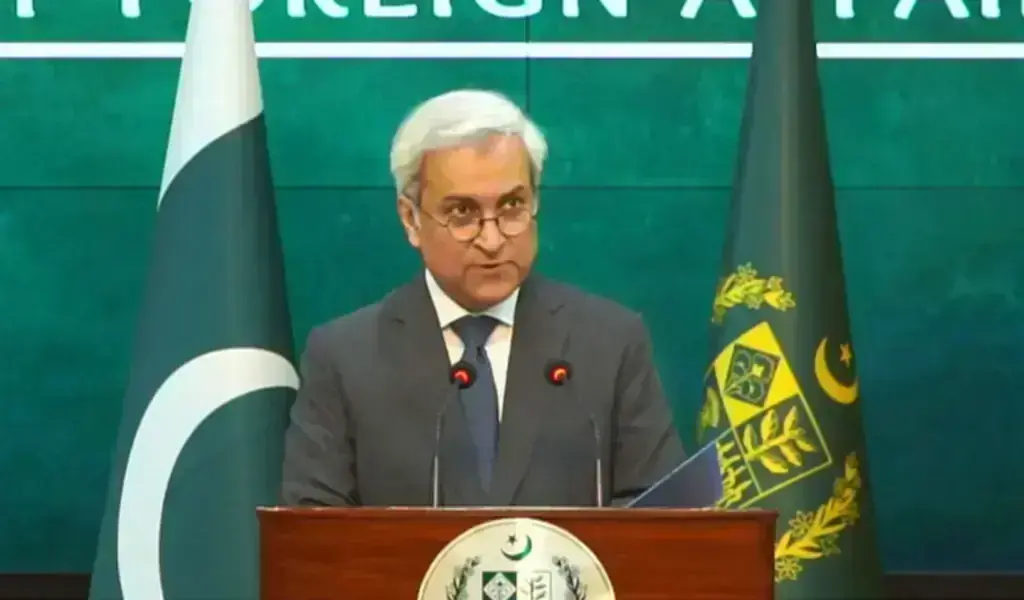
Pakistan on Thursday rejected allegations made in a recent Amnesty International report regarding its military strikes in Afghanistan, saying the claims were made without credible evidence and ignored the root cause of terrorism originating from Afghan soil.
Addressing the weekly media briefing, Foreign Office Spokesperson Tahir Andrabi said Pakistan completely rejected the report’s allegations and maintained that any military action taken by the country was carried out in exercise of its right to self-defence, in line with international law.
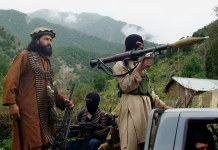
He said terrorist groups, including Tehrik-i-Taliban Pakistan (TTP), the Balochistan Liberation Army (BLA) and other affiliates, continued to enjoy sanctuaries inside Afghanistan under the Taliban administration, enabling them to plan and launch cross-border attacks against Pakistan.
The spokesperson said thousands of Pakistanis had lost their lives in terrorist attacks planned and supported from Afghan territory. He added that Pakistan’s operations were directed only against terrorist hideouts and logistical bases, while observing the principles of distinction, precaution and proportionality.
Calling on the international community to address the real source of regional instability, Andrabi urged Amnesty International to scrutinise the Afghan Taliban’s continued support for terrorist groups and to hold the regime accountable for its commitments under relevant United Nations Security Council resolutions and the Doha Agreement.
The spokesperson also strongly condemned recent threats by Yemen’s Houthi militia against Saudi Arabia and commercial shipping in the Red Sea.
He said Pakistan viewed any hostile act against Pakistani-flagged vessels or the country’s maritime interests as a grave threat to national security and reserved the right to take all necessary measures in self-defence in accordance with international law.
Responding to a question later in the briefing, Andrabi stressed that Pakistan’s sovereignty and security were a “red line,” adding that any attack on Pakistani interests would be considered an attack on Pakistan and would receive an appropriate response.
The spokesperson also reaffirmed Pakistan’s unwavering support for Saudi Arabia’s security, sovereignty and territorial integrity, while expressing concern over attempts to widen the ongoing Middle East conflict.
He said Pakistan continued to advocate dialogue and diplomacy to reduce tensions in the region. In this regard, he highlighted the recent visit of Iranian Foreign Minister Iskandar Momeni to Pakistan, during which he met Prime Minister Shehbaz Sharif, the Interior Minister, and the country’s military leadership.
The spokesperson said Pakistan was also actively engaging regional partners. He noted that Deputy Prime Minister and Foreign Minister Ishaq Dar had held discussions with the foreign ministers of Kuwait, Egypt, Oman and Russia on the sidelines of meetings in Manila, focusing on de-escalation, regional stability, maritime security and bilateral cooperation.
He added that DPM/FM Dar would also lead Pakistan’s delegation to the Shanghai Cooperation Organisation Council of Foreign Ministers meeting in Bishkek, where he would hold bilateral meetings with counterparts from member states.
Ishaq Dar also represented Pakistan at the 31st ASEAN Regional Forum Ministerial Meeting in Manila, reaffirming Pakistan’s commitment to regional peace, dialogue and cooperation.
On bilateral relations with Canada, Andrabi said Canadian Foreign Minister Anita Anand’s visit to Pakistan marked the first such visit in two decades. He said both countries discussed trade, investment, climate cooperation, regional issues and people-to-people exchanges.
He added that Pakistan and Canada had signed a protocol on phytosanitary import requirements for genetically modified canola, facilitating agricultural trade and strengthening bilateral economic cooperation.
Responding to a question on the European Commission’s latest GSP Plus monitoring report, Andrabi welcomed the report’s recognition of Pakistan’s legislative progress and continued compliance with the 27 international conventions under the framework.
However, he expressed disappointment with the report’s overall narrative, saying it did not present a balanced assessment of Pakistan’s achievements since joining the GSP Plus scheme in 2014.
He said GSP Plus remained central to Pakistan’s economic partnership with the European Union, supporting exports, employment, women’s economic participation and poverty reduction, while reaffirming Pakistan’s commitment to implementing international obligations.
On Afghanistan, the spokesperson said Pakistan remained committed to facilitating Afghan nationals through legal channels and had already helped more than 90,000 Afghans relocate to third countries.
He stressed that Afghan citizens must possess valid documents to stay in Pakistan, noting that those residing illegally remained subject to deportation under the country’s laws. At the same time, he said Pakistan continued to regard ordinary Afghan nationals as brothers and rejected any stereotyping or hatred against them despite security concerns.
The spokesperson also reiterated Pakistan’s continued support for the Palestinian cause, saying Islamabad remained engaged with Islamic countries on efforts to achieve peace and continued to advocate the establishment of an independent Palestinian state in accordance with international law.
Replying to another question, the spokesperson said Pakistan would continue raising its voice against human rights violations in Indian Illegally Occupied Jammu and Kashmir (IIOJK).
He also referred to convicted Indian spy Kulbhushan Jadhav, describing him as evidence of India’s involvement in activities aimed at destabilizing Pakistan.