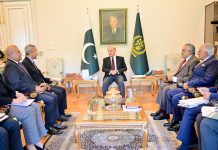
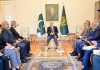
Pakistan and Singapore on Friday emphasised further strengthening bilateral cooperation across multiple sectors, particularly focusing on trade and investment, education, technology, culture, people-to-people contacts and disaster management.
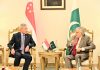
The bilateral ties and cooperation were discussed during the restricted meeting and delegation-level talks between Deputy Prime Minister and Foreign Minister Senator Ishaq Dar and Singapore’s Foreign Minister Dr. Vivian Balakrishnan, who arrived here on an official visit earlier in the day.
In his remarks, Deputy Prime Minister Dar underscored the long-standing and friendly relations between the two nations, with Pakistan having been among the first countries to recognise Singapore’s independence in 1965, and that Singapore’s Foreign Minister’s visit to Pakistan was the first in over two decades.
The deputy prime minister said that during the talks, both sides welcomed the growth in bilateral trade and agreed to encourage closer business-to-business engagement, leveraging chambers of commerce and business delegations.
He said both sides recognised the considerable untapped potential in relations and stressed the importance of sustained engagement.
The two foreign ministers agreed to hold regular bilateral political consultations and promote high-level exchanges to strengthen cooperation between the two governments and institutions.
Deputy Prime Minister Dar said that the reopening of Pakistan Trade and Investment Office at Pakistan High Commission in Singapore was a testament to the country’s resolve to promote stronger B2B ties.
He said that beyond trade and investment, Pakistan and Singapore discussed expanding cooperation in education, research, digital technologies, and artificial intelligence, besides agreeing to deepen cooperation in human resource development, agriculture, and climate domains.
Both sides discussed strengthening institutional linkages between their universities and research institutions, as well as promoting cultural, academic, youth, and people-to-people exchanges, alongside the potential resumption of direct flights to facilitate travel.
He told the media that both countries exchanged a Memorandum of Understanding on disaster management between Pakistan’s National Disaster Management Authority (NDMA) and the Singapore Civil Defence Force (SCDF).
On multilateral and regional affairs, he emphasised Pakistan’s engagement with ASEAN, wished Singapore success for its 2027 ASEAN chairmanship, and reaffirmed the need for secure maritime trade routes, adherence to international law, and dialogue to resolve regional and global challenges.
Ishaq Dar told his Singaporean counterpart that Pakistan remained engaged with key regional and international partners to encourage continued dialogue and diplomacy, which remained the only viable means to resolve outstanding challenges.
On Palestine, he expressed concern over the continued expansion of illegal settlements and efforts to alter the status of the West Bank and Al-Aqsa Mosque, reiterating strong support for an independent, sovereign, viable, and contiguous state of Palestine, based on pre-June 1967 borders, with Al-Quds Al-Sharif as its capital.
In the context of South Asia, he called for a just, durable, and peaceful settlement of the long-standing Jammu and Kashmir dispute in accordance with the relevant UN Security Council resolutions.
He said as both nations marked 60 years of diplomatic relations, they were committed to deepening this partnership and building a more prosperous future for our two peoples.
In his remarks, Singapore Foreign Minister Dr. Vivian Balakrishnan underscored the need to scale up trade, economic cooperation, and institutional linkages with Pakistan, emphasising that despite excellent diplomatic relations, bilateral trade volumes ought to be significantly higher.
Calling for facilitating greater bilateral trade and investment, he said that economic figures should match the excellent political and diplomatic ties, besides stressing strengthening connections between Small and Medium Enterprises (SMEs) and business communities in South Asia and Southeast Asia.
He said that governments must proactively facilitate business interactions and identify new mutually beneficial ventures, and identified carbon credits and carbon markets as a highly promising avenue for joint work.
He told the media that Singapore would learn from Pakistan’s extensive experience in managing large-scale natural disasters and extreme climate events, and highlighted collaboration in early warning systems, best practice sharing, search and rescue capabilities, and joint training exercises.
Foreign Minister Vivian Balakrishnan welcomed deeper institutional cooperation between Singapore’s Nanyang Technological University (NTU) and National University of Singapore (NUS) with Pakistan’s National University of Sciences and Technology (NUST).
He commended Pakistan’s constructive role during current regional crises, particularly in the Gulf, noting that stable energy flows through the region were vital for East Asia, South Asia, and Southeast Asia.