The survey identifies 2023 as the worst year for natural disasters in 43 years. Floods emerge as major risk to growth, employment opportunities: PES-2026
JAVED KHAN MOHMAND
PESHAWAR
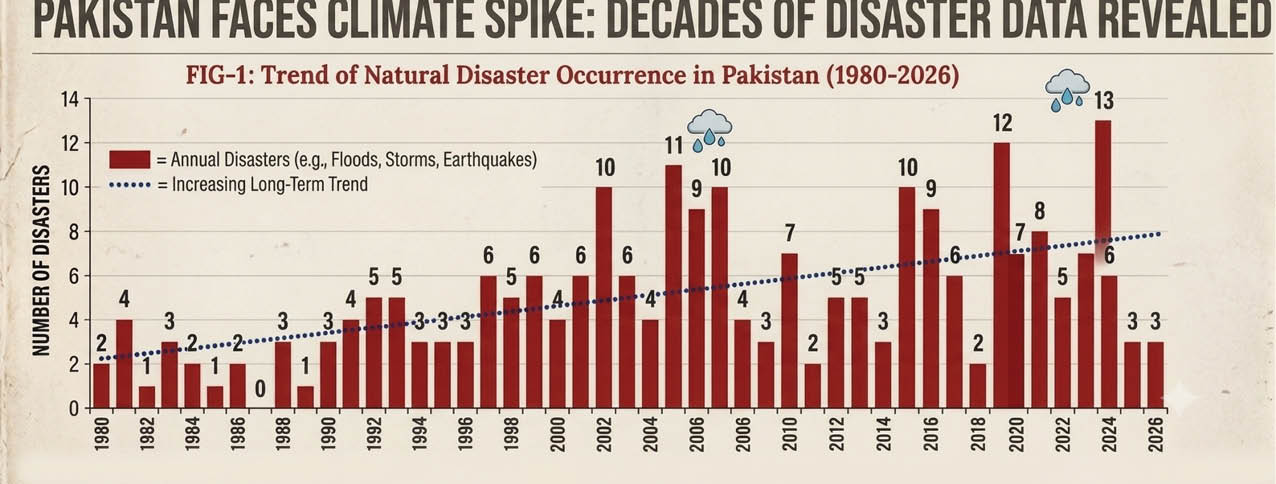
Pakistan has experienced a gradual but clear increase in the frequency of natural disasters since the early 1990s, reflecting growing vulnerability to climate-related hazards, according to the Pakistan Economic Survey 2025–26.
The survey, presented by finance minister Muhammad Aurangzeb in a press conference in Islamabad, covered climate related data from 1980 to 2026, which showed that disaster occurrences in the 1980s remained relatively low, with annual events ranging between zero and four. However, from the 1990s onwards, the frequency began to rise steadily, showing more consistent fluctuations over time.
The report noted a sharper increase after 2000, when annual disaster events frequently rose to between six and 11 incidents. The statistics of the survey postulated the trend became more pronounced after 2015, with repeated occurrences of floods, storms, heatwaves, droughts and landslides across the country.
It identifies 2023 as the most disaster-prone year in more than four decades, with 13 recorded events, highlighting an increasing intensity of climate-related risks in Pakistan.
The survey states that the upward trend reflects a structural shift rather than isolated incidents, indicating that disasters are becoming more frequent over time and not just cyclical occurrences. It adds that this situation underscores the need for stronger climate resilience, disaster preparedness and risk management systems.
Alongside this trend analysis, the survey also highlighted the severe impact of the 2025 floods, which caused widespread devastation across the country.
Total damages were estimated at Rs822 billion, with more than 1,039 deaths, over four million displaced people and around 6.5 million affected across 70 districts. Nearly 77 per cent of the losses occurred in Punjab, it added..
According to the Flood Assessment Report 2025, the agriculture sector suffered losses of Rs430 billion, including Rs422.6 billion in crop damage, raising concerns over food security and export performance.
Infrastructure losses stood at Rs307 billion, with road networks accounting for Rs187.7 billion, followed by housing at Rs91.2 billion. Other infrastructure, including bridges and water and energy systems, suffered losses of Rs28.05 billion.
The report further said more than 229,000 housing units were damaged, while extensive road networks and public infrastructure were destroyed, putting additional pressure on recovery efforts and public finances.
Punjab remained the worst-hit province, accounting for Rs631 billion, or 76.8 per cent of total losses.
The survey warned that the floods could increase unemployment by around 0.2 million in FY2026 and revised the GDP growth forecast downward to 3.5–3.9 per cent, compared to the earlier target of 4.2 per cent.
It added that Pakistan, despite contributing less than one per cent to global emissions, continues to bear a disproportionate burden of climate change impacts, with rising temperatures and shifting monsoon patterns intensifying extreme weather events across the country.
At the provincial level, the survey noted various climate-related initiatives, including Punjab’s environment endowment fund and AI-based monitoring systems of emissions from industrial sector, Sindh’s wastewater treatment and renewable energy projects, Khyber Pakhtunkhwa’s forestry and biodiversity efforts, and Balochistan’s climate governance and pollution control measures.