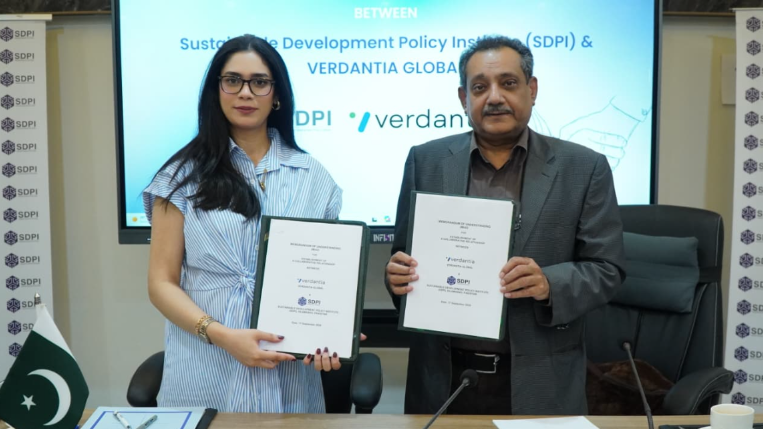
The Sustainable Development Policy Institute (SDPI) and Verdantia Global on Thursday signed a Memorandum of Understanding (MoU) to develop synergies aimed at scaling up local capacities to enhance Environmental, Social and Governance (ESG) and sustainability reporting on carbon emissions for Pakistan’s export sector, industry, and businesses.
The MoU was signed by Dr. Shafqat Munir, Deputy Executive Director (Research), SDPI, and Fatima Bajwa, CEO, Verdantia Global, on behalf of their respective organizations, said a press release.
Speaking on the occasion, Dr. Shafqat Munir said the MoU was the outcome of repeated prior interactions and similar core areas of work such as sustainability and impacts of climate change. He said since Verdantia Global’s mandate is sustainability for business, and SDPI’s mandate is sustainability for development, the two organizations have common ground to collaborate on research, capacity building.
He said sustainability and ESG reporting themes were gaining momentum among Pakistani businesses, which were increasingly looking for ESG reporting tools and capacity.
He observed that the issue of ESG reporting differs for global players, who are among the largest polluters, compared to industries in the South that primarily affect their own local environment. He said Pakistan’s emissions rate differs from that of developed nations.
He said that existing ESG reporting software costs around $30,000 annually, underlining the need for accessible and low-cost alternatives which could be developed through partnership between SDPI and Verdantia Global.
Fatima Bajwa, CEO, Verdantia Global, said the MoU materialized after consistent engagement with SDPI’s work, which she found to be an institution of considerable credibility and merit. She said several common areas of cooperation were identified during bilateral discussions. She said Verdantia Global is a sustainability consultancy forum that helps businesses establish ESG compliance and sustainability practices.
She said businesses today require a complete framework and reporting structure to report their greenhouse gas (GHG) emissions, an area in which Pakistan lags behind. She said large companies increasingly require their suppliers to follow such frameworks, and that small suppliers need dedicated sustainability teams to manage reporting. She said Pakistan needs credible organizations to help businesses report on sustainability, adding that her organization works with developed countries in this regard.
She said SDPI’s Centre for Learning and Development (CLD) is a good match for efforts to promote ESG reporting, noting that the right training and framework are essential to proceed on ESG reporting. She added that the United States also follows European Union markets in adopting practices such as ESG reporting, and said Pakistan’s export sector currently lacks adequate ESG reporting mechanisms. She said the gap between developed and developing countries in this regard needs to be addressed.
Romila Qamar, Research Associate SDPI, said the MoU marks an important step towards strengthening institutional collaboration and exploring avenues for future cooperation between the two organizations.