ZUBAIR QURESHI
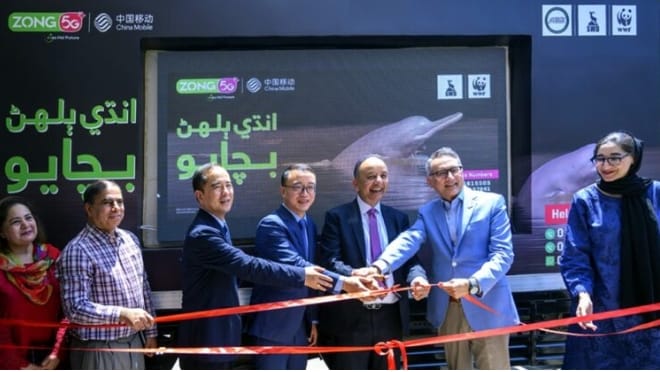
Pakistan’s fastest growing Telecom operator Zong and WWF-Pakistan unveiled on Tuesday a dedicated Indus Dolphin Rescue and Mobile Awareness Ambulance, a unit designed to speed up emergency response for one of the world’s rarest freshwater dolphin species.
The launch ceremony, held at WWF-Pakistan’s Islamabad office, drew Federal Minister for Climate Change and Environmental Coordination Dr. Musadik Malik, Zong Chairman and CEO Huo Junli, WWF-Pakistan Director General (DG) Hammad Naqi Khan, and Chinese Embassy representative Yang Guangyuan.
Dr. Malik noted that the species predates every civilization that has risen along the Indus and calling its survival, despite being blind, a lesson in living with nature without needing to see it.
He thanked Zong Telecom and the Chinese Embassy for backing the project and for broader efforts to expand connectivity in underserved parts of the country.
In his remarks, Zong’s Chief Regulatory Officer, Kamran Ali, described the ambulance as a tangible sign of the company’s environmental commitment after nearly two decades operating in Pakistan, and framed it as part of a deepening China-Pakistan partnership on conservation.
WWF-Pakistan’s Hammad Naqi Khan put the initiative in context: the country is now home to roughly 2,000 Indus River dolphins, and since 1992 the organization’s work with Sindh and Punjab wildlife departments has helped rescue and release more than 200 stranded animals.
The new ambulance, he said, will sharpen that emergency response and monitoring capacity going forward. Found nowhere else on Earth, the Indus River dolphin has been pushed toward extinction by habitat fragmentation, dwindling freshwater flows, and dolphins accidentally becoming stranded in irrigation canals.

The new mobile unit will patrol the stretch between the Guddu and Sukkur barrages in Sindh – home to the species’ largest surviving population – monitoring for stranded animals and supporting rescue and safe translocation efforts.
Beyond emergency response, the program plans to engage more than 1,500 fisherfolk and riverine community members as frontline conservation partners and to run 50 awareness sessions in remote settlements along the river.
The partnership fits into Zong’s broader sustainability strategy, which centers on low-carbon operations and inclusive growth, positioning the ambulance as an example of private-sector investment.