Beijing
Capping a week of courting the world’s top CEOs, China’s President Xi Jinping on Friday made one of his most impassioned defences yet of international trade, as the system of globalised supply chains that helped catapult China to economic superpower status teeters on the brink.
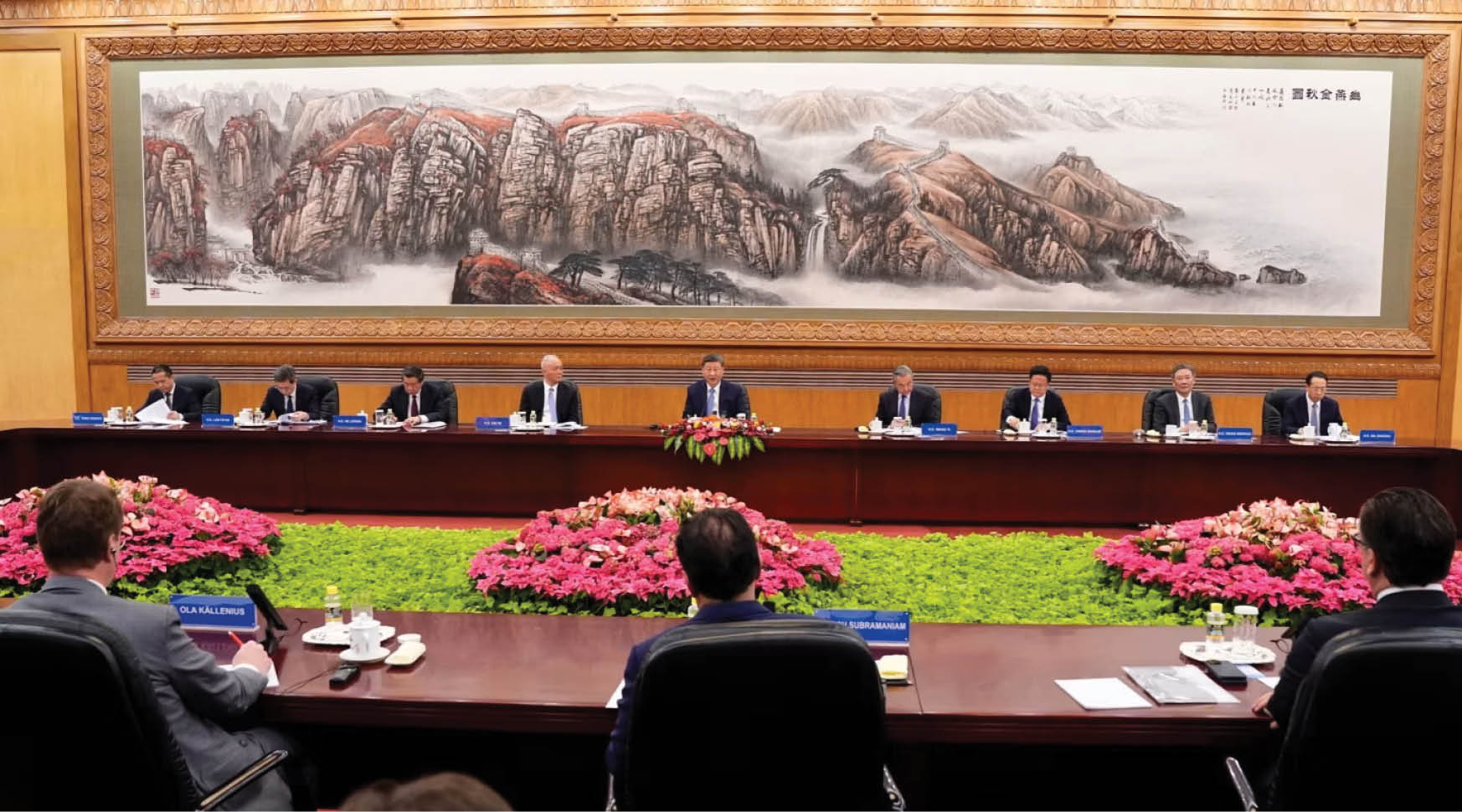
Just days before Donald Trump’s self-declared “liberation day” on April 2, when the US president is set to unleash a new wave of tariffs on America’s trading partners, a smiling Xi led a group of more than 40 global business leaders into an ornate room in Beijing’s Great Hall of the People.
Without naming the US, Xi told his guests, who ranged from HSBC’s Georges Elhedery and Mercedes-Benz’s Ola Källenius to Saudi Aramco’s Amin Nasser and Toyota’s Akio Toyoda, that some countries were “weaponising” trade and “forcing companies to take sides and make choices that go against economic principles”.
“We must jointly maintain the multilateral trading system, jointly maintain the stability of the global industrial chain,” he said.
The meeting with the business leaders followed a week in which China hosted its most important annual business summits: the China Development Forum in Beijing and the Boao Forum for Asia in the tropical resort island of Hainan.
The message at both was that, compared with Trump’s chaotic policymaking, Beijing was a bastion of stability and a champion of the global trading system from which it — arguably more than any other country — had benefited and upon which it was still heavily reliant.
Trump has threatened to impose sweeping “reciprocal” tariffs on America’s trading partners on Wednesday. The US is due on Tuesday to conclude extensive investigations into its trade with China as well as Beijing’s industrial policy, subsidies and diversion of trade through other countries.
Analysts said many foreign trading partners have soured on China in recent years, accusing it of running up huge surpluses while erecting barriers to its domestic market. But Trump’s threats to globalisation have made international business more receptive to Beijing’s message.
“China after all is quite stable — there are no surprises in policymaking,” said Denis Depoux, global managing director at consultancy Roland Berger, who attended the Beijing and Bo’ao forums. “Maybe because the rest of the world has become chaotic, so China looks better than before.”
At the annual meeting of China’s rubber stamp parliament this month, leaders sought to shore up that image of stability with an ambitious GDP annual growth target of 5 per cent, backed by plans for a record central government budget deficit.
“If you’re wanting to ask about China and its place in the globe, in the world, what I’m witnessing is a quiet resoluteness, that they believe they’re on the right path,” said Andrew Forrest, the Australian mining billionaire who also attended both forums.
“No matter the changes in the external environment, China will open wider to the world,” vice-premier Ding Xuexiang, a member of the elite standing committee of the Communist party’s governing politburo, assured those gathered in Bo’ao.