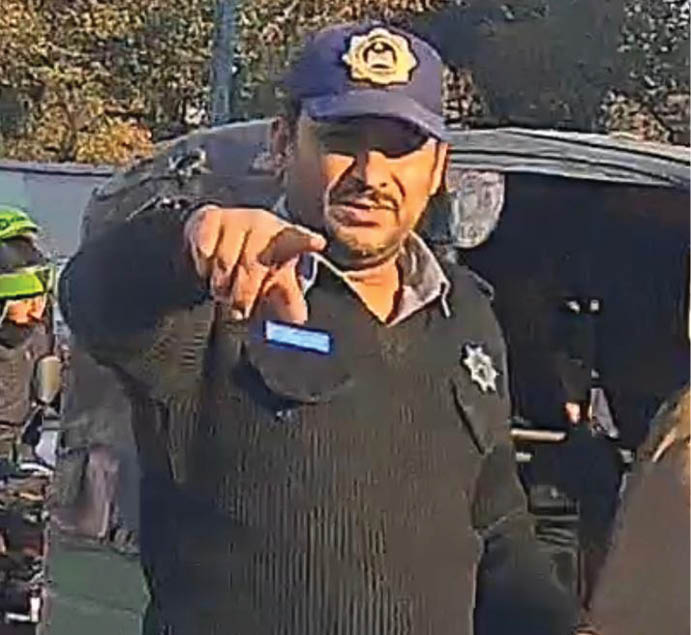
On a busy junction in Peshawar, a routine traffic manoeuvre turned into a troubling confrontation, one that raises serious questions about how authority is exercised on the city’s roads. According to the account of a citizen involved in the incident, a lawful U-turn, taken at a junction where no prohibitory signage exists and where motorists routinely turn, was met not with a traffic citation, but with hostility, threats, and coercion. What followed, the citizen alleges, was not traffic enforcement but intimidation.
When stopped, the motorist calmly requested that, if any violation was believed to have occurred, a challan be issued. He expressly stated that he had no objection to receiving a citation and would challenge it through the courts if necessary. However, no challan was issued and instead, the traffic warden allegedly escalated the encounter, threatening arrest and repeatedly stating words to the effect of: “I will teach you what the law is”.
Despite the absence of any citation and despite the fact that the alleged violation, at most, concerned a minor traffic issue, the motorist was allegedly threatened with jail. The situation deteriorated further when the traffic warden insisted that the vehicle reverse into live traffic, without stopping vehicles behind. The result, according to the complainant, was a collision that caused damage to the car due to the insistence of the traffic warden.
Perhaps most disturbing is the allegation that even after the citizen identified himself as a lawyer, the threats continued. The rule of law, critics argue, does not depend on one’s profession, but neither does it permit threats of arrest where no arrestable offence exists. The incident did not end with accountability as no ticket was issued even issued except for threats. No legal process was initiated. The motorist was eventually told to leave, after public humiliation, threats and property damage. Importantly, this incident is not based solely on verbal claims. Dash cam footage and still images reportedly exist, capturing the traffic warden’s conduct during the encounter. One such image is now circulating, raising broader public concern.
There are growing complaints, still allegations, but persistent ones, against a traffic warden identified as Iftikhar Ahmed, who is accused by multiple citizens of rude, dismissive and threatening behaviour. Some complainants allege that motorists are spoken to not as citizens but as subjects, ordered, insulted and intimidated rather than cited under law. The issue at stake is larger than one U-turn or one confrontation. Traffic wardens are empowered to regulate traffic, not to threaten incarceration, not to compel unsafe manoeuvres and certainly not to act as if the road is a personal fiefdom. When enforcement replaces procedure with fear, the public’s trust erodes rapidly. Law enforcement authority flows from law, not from intimidation. If traffic violations occur, the law provides a simple remedy, issue a citation and allow the courts to decide. Threatening jail without due process is not enforcement, it is abuse of power.
The Chief Traffic Officer – Peshawar and the DIG – Traffic, now face a moment of institutional responsibility. Where credible complaints exist, especially where video evidence is available, immediate, transparent inquiries are not optional, they are essential. Suspension during investigation, reassignment from public-facing duties and public disclosure of outcomes are standard safeguards in functioning systems. Citizens do not expect leniency. They expect legality. They do not demand immunity. They demand dignity. If traffic wardens begin to act like goons rather than officers, like street strongmen rather than public servants, the cost will be borne not just by motorists, but by the legitimacy of the entire system.