KABUL
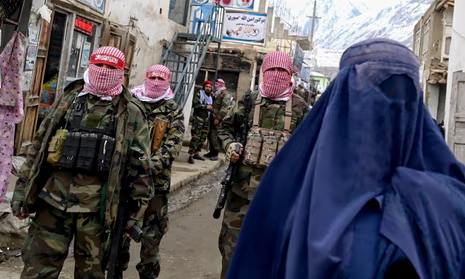
An Afghan woman who risked her life to defend human rights in her home country before fleeing to the UK has been told by the Home Office it is safe for her to return after officials rejected her asylum claim.
Mina (not her real name) worked for western government-backed projects and was involved in training and mentoring women across Afghanistan, which left her in grave danger even before the Taliban took over in 2021.
“I assumed my asylum claim would be granted – I am from Afghanistan, I’m a woman, I worked with western governments,” said Mina. “The refusal was an absolute shock. Now every day I fear being sent back to my home country. Having a normal life here looks like a dream for me. I’m really suffering mentally.
“When I was working with western government projects I received security training about how to respond if I was caught up in a bombing or a kidnapping. Every day I was a few minutes or a few seconds away from bomb blasts.
“My heart beat so fast when I had to pass the checkpoints. Every morning when I said goodbye to my family to go to work I thought it might be the last time I saw them,” she said. “Some of my colleagues just disappeared. The Taliban changed the Ministry of Women’s Affairs to the Ministry of Vice and Virtue – proper, systematic elimination of women.”
The Home Office has previously generally accepted protection claims from women like Mina who could be targeted by the Taliban because of their high-profile work empowering women and who have provided evidence of their work with western government projects.
But in the most recent data for the last three months of 2024 immigration statistics show 26 Afghan women had their claims rejected. Overall 2,000 Afghan asylum seekers had their claims refused, an increase from 48 in the same quarter of 2023. The grant rate for Afghan cases has gone down from 98.5% in the last quarter of 2023 to 36% in the last quarter of 2024.
The 2025 Human Rights Watch report into Afghanistan documents a serious deterioration in the rights of girls and women and an increase in risks to their safety.
Although Mina explained in her Home Office asylum interview of the dangers she faced in Afghanistan because of the work she did a Home Office decision maker who rejected her claim, concluded that: “It is considered that you do not face a real risk of persecution or harm on your return to Afghanistan on the basis of your claimed adverse attention by the Taliban.”
The refusal letter adds: “You likely have a great support network due to your occupation.”