Sajjad Ahmad Khan
Although hundreds of soldiers have been deployed to the affected areas to help stranded residents, yet thousands are waiting to be rescued
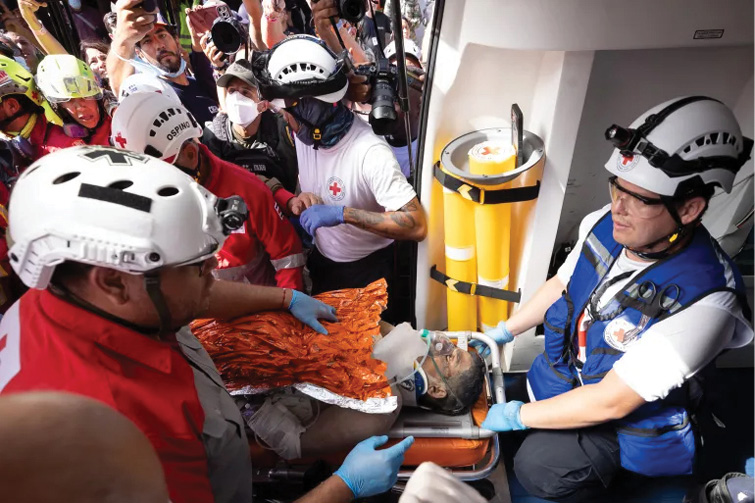
The government of Pakistan has termed the devastating floods caused by the deadly monsoon rains as a “climate humanitarian crisis and a climate dystopia at our door step”. The report of environmental group Germanwatch has already placed Pakistan in the list of countries which may face the fury of climate change, ranking Pakistan eighth in table of such vulnerable countries. We have to take strong measures to prevent the disasters caused by the climate change. Such measures will act as a robust bulwark in mitigating the erratic weather conditions. Now we have to be on gaud since natural disasters can strike us anytime due to extreme shift in temperature. It is worth mentioning here that the effects of change in weather pattern are not limited to only one region, but the dinosaur can set its feet anywhere at any time. The death toll from the floods, in Pakistan, has reached 1033 so far, but there is a strong possibility that this number may rise. Aside from fatalities, the ferocious floods have cost Pakistan 900 billion, affecting more than 33 million people across the country. The situation is further complicated by the inundation of infrastructure including roads and bridges, hampering both the evacuation of people to safe places and the delivery of aid. The homeless and hapless people are sitting under the open sky looking for a helping hand. This is not the time to play politics or blame anyone. Rather, the need of the hour is that we should come forward to assist the people who are surrounded by the hellish waves of the flood, beseeching for life. This crisis is so colossal that we will not be able to face it alone. We will need the help of international humanitarian organizations and the world community. The government, both provincial and federal, have stepped in to provide relief to the affected people. The government is collecting aid both in cash and kind for the relief of the affected people. After scores of evacuation orders by the local administration, the rescue process has begun to save precious lives of people being marooned in different affected areas. The devastation caused by torrential rains and floods across the country has left several heart-wrenching stories everywhere. The water from which life grows came here as a heavenly torment which wolfed down all the joys and traces of life. According to the data shared by the government, the highest number of deaths and injuries were recorded in Sindh and Baluchistan during this period. Damages are yet to be formally assessed, but the situation appears dire at first glance. The torrential rains swept away the crops, pastures and innumerable livestock in a few moments. In many areas, transport and communication networks have been completely disrupted. The government is still facing many difficulties in reaching the stranded people. Agriculture is the backbone of Pakistan’s economy. If this loss is not compensated immediately, the economic foundations of Pakistan will definitely start to shake. Here I have presented a brief overview of the flood and its devastation.
Now let’s have a brief chat over the future modus operandi. Currently, we are in the rescue stage. After that, the process of early recovery and later rehabilitation will begin. The more time passes between the two phases, the greater the loss of life and money will be. The best strategy would be that the teams of government, aid agencies , local and international NGOs should make preparations for early recovery from right now.
The organizations must gird up to begin Rapid Need Assessment to collect and analyze information on affected people and their needs. The Multi-Cluster/Sector Initial Rapid Assessment (MIRA) is a significant assessment tool that can be used in sudden onset emergencies. The government should immediately set up a centralized crisis response task cell. With the help of this cell, communication will be restored among various departments and required information about the victims will also be furnished to the concerned organisations.
In the years 2005 and 2010, Pakistan has faced such disasters on a large scale, though less than the current one. What we learned then is a lesson learned for us today. It is a fact that masses give donations generously in such situations. International humanitarian organizations also come forward for assistance. But unfortunately the donations are not used they way it should be. Many projects fail to achieve the desired objectives due to weak monitoring system and nepotism or other inbuilt flaws in the implementation process. Technically speaking, most projects have loop holes in the target mechanism of the communities. A thin class (employees) of the institutions later on take advantage of the very shortcomings and reward their favourites instead of the deserving lot. I have been a development practitioner myself so I know very well how people fill up their pockets in the name of humanitarian aid.
Although hundreds of soldiers have been deployed to the affected areas to help stranded residents, yet thousands are waiting to be rescued. Unfortunately, incidents have come up which are reprehensible and need to be investigated. In this regard, the incident of drowning of five brothers in Khyber Pakhtunkhwa (Dir) has sent a shiver down since despite repeated SOS and emergency calls helli services were not provided to the drowning brothers . These five brothers have lost their lives while waiting for the helicopter. After this painful incident, the impression was viral throughout the province that the official helicopter of KP is reserved for the personal use of Imran Khan and the Chief Minister of the province. About 200 people have been killed in the province of Khyber Pakhtunkhwa and the economic damage to the province is estimated in billions. This province has been a victim of terrorism for the past few years as a result of which Khyber Pakhtunkhwa was devastated economically. This unfortunate province was hit by floods in 2010 which caused irreparable damage due to which poverty and unemployment increased tremendously.