BEIJING
Chinese President Xi Jinping chaired a meeting of top leaders about rescue operations in Tibet on Friday, two days after a landslide hit the Nepal-China border. “All efforts must be made to search for and rescue missing people inside and outside of the country,” officials of the Chinese Communist Party’s Politburo said at the meeting, according to Xinhua News Agency.
“There are still many hidden dangers of glaciers, ice lakes and geological disasters in the surrounding area, and rescue is facing great difficulties,” Xinhua reported the leaders saying, adding that China was considering emergency aid to Nepal and “international relief cooperation.”
Nepal issued a warning on Friday to move to higher ground after a dam upstream in Tibet was reported to have burst, two days after a glacial collapse caused deadly flooding.
“Information has been received that a water dam has burst again on the Tibetan side,” police said in a statement.
“All security personnel, rescue workers, and the general public deployed in rescue and relief operations are requested to remain alert and immediately move to a safe location/report the incident.”
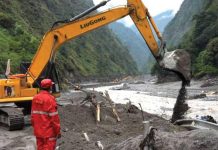
China paused a rescue operation on Friday citing the high risk of renewed flooding in Tibet, where hundreds remain missing two days after a deadly mudslide, state media said.
A lake formed by immense piles of debris after a mudslide hit the China-Nepal border has begun overflowing toward the area that rescue teams were headed, state broadcaster CCTV said. “All rescue teams have been ordered to stand by in place and wait for further instructions,” it said.
Emergency teams which had earlier accessed the area “have been ordered to withdraw one kilometer (0.6 miles),” the broadcaster added. The lake formed after a wall of mud and debris hit the border hub of Gyirong in Tibet on Wednesday, with hundreds reported missing.
CCTV said water levels at the lake were expected to rise over the next three days due to continued rainfall, peaking around September 1. This increases “the risk of a breach that could send floodwaters downstream and potentially cause further damage in areas including Gyirong Port and elsewhere downstream,” state news agency Xinhua reported late Thursday.
Emergency engineering teams were closely monitoring the situation, said CCTV. CCTV said that 499 Chinese nationals and 555 foreigners had been transported out of the disaster zone as of Friday. Rescue workers are using drone-based 3D modeling and thermal imaging detection, as well as manual searches, to locate those still missing, said CCTV.