Islamabad:
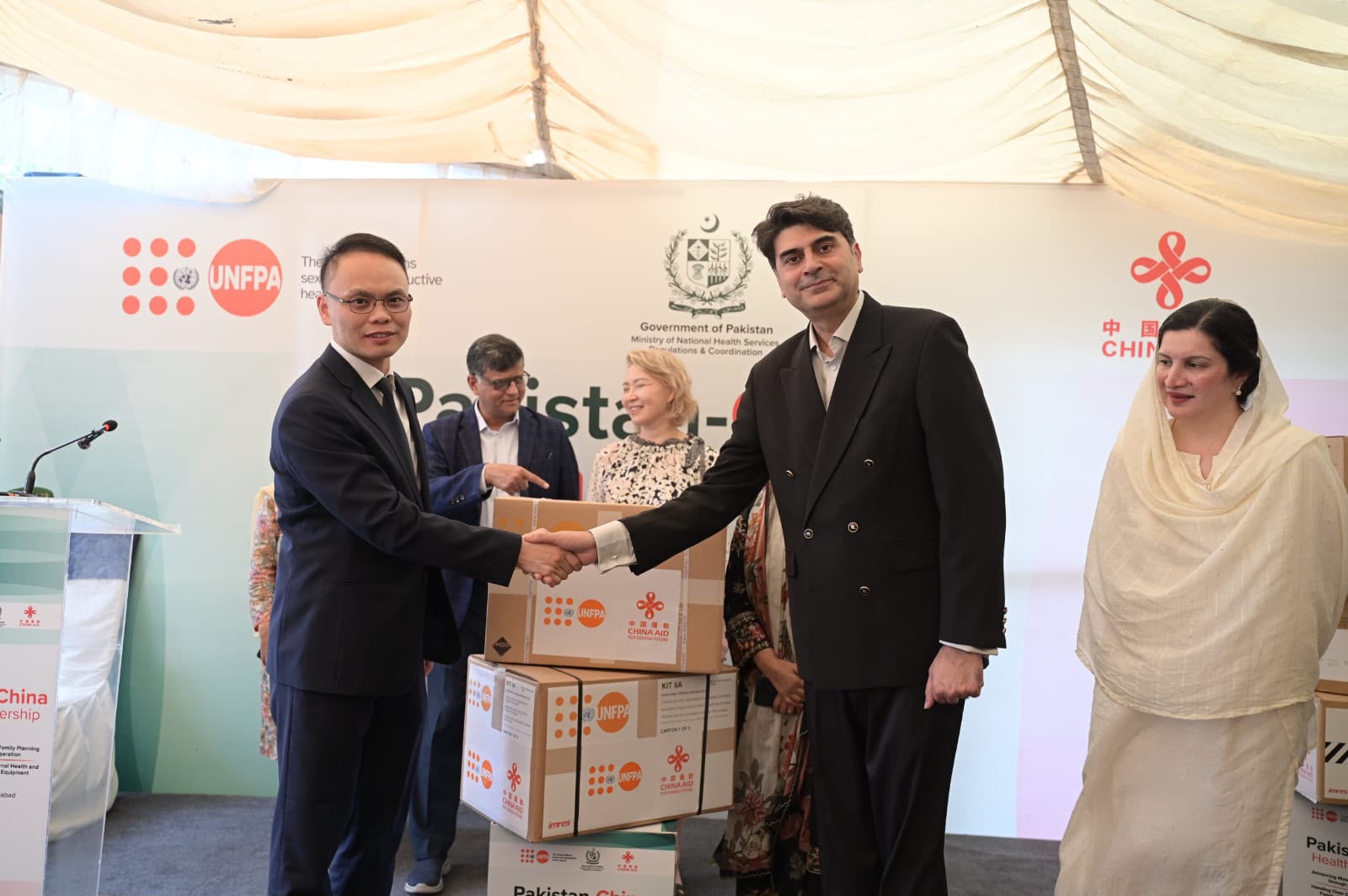
The government of the People’s Republic of China (PRC) with the support of the United Nations Population Fund (UNFPA), here on Thursday handed over reproductive health and family planning supplies and equipment worth $2 million to the Ministry of National Health Services, Regulations and Coordination (MoNHSR&C) to strengthen maternal and newborn healthcare services in underserved areas of Pakistan.
The handover ceremony was held at the Rural Health Centre (RHC) Tarlai, Islamabad, where Minister of State for National Health Services Dr. Malik Mukhtar Ahmad Bharath received the supplies from Zhang Datuo, Second Secretary at the Chinese Embassy in Pakistan. The ceremony was also attended by UNFPA Pakistan Deputy Representative Dr. Gulnara Kadyrkulova, Director General Population Programme Wing Dr. Shabana Saleem and District Health Officer Islamabad Dr. Syeda Rashida Batool.
The consignment includes reproductive health and midwifery kits, two-rod contraceptive implants, clean delivery kits and newborn baby kits. The supplies will be distributed across 10 underserved districts, including Kech, Loralai and Khuzdar in Balochistan; Hyderabad in Sindh; Rahim Yar Khan and Kasur in Punjab; Charsadda in Khyber Pakhtunkhwa; Gilgit in Gilgit-Baltistan; and Kotli in Azad Jammu and Kashmir.
According to officials, more than 300,000 women and girls of reproductive age are expected to benefit from the initiative. In addition to the provision of supplies, healthcare providers in the target districts will receive training to improve the quality of maternal healthcare and family planning services.
Speaking on the occasion, Zhang Datuo reaffirmed China’s commitment to supporting Pakistan’s maternal health and family planning efforts under the Global Development Initiative and the South-South Cooperation Programme, saying the partnership would help improve healthcare access for women and families in underserved communities.
Addressing the ceremony, Minister of State Dr. Mukhtar Ahmad Bharath warned that Pakistan’s rapidly growing population presents a serious national challenge and said that, without timely and effective interventions, the country’s population could approach 400 million by 2040.
He stressed that family planning is not simply about limiting births but about ensuring that every child is born into a healthy, safe and dignified environment. He urged parents to consider their ability to provide adequate nutrition, quality education, healthcare, immunisation and proper upbringing before planning their families.
The minister said sustainable population management requires the collective efforts of the government and society, adding that a healthy and prosperous nation can only be achieved when every child enjoys access to basic rights and opportunities. Dr. Bharath also said Prime Minister Shehbaz Sharif has constituted a National Council to address Pakistan’s population challenges. The council is working on a comprehensive national strategy to promote balanced population growth, improve maternal and child health, and strengthen family planning services across the country.