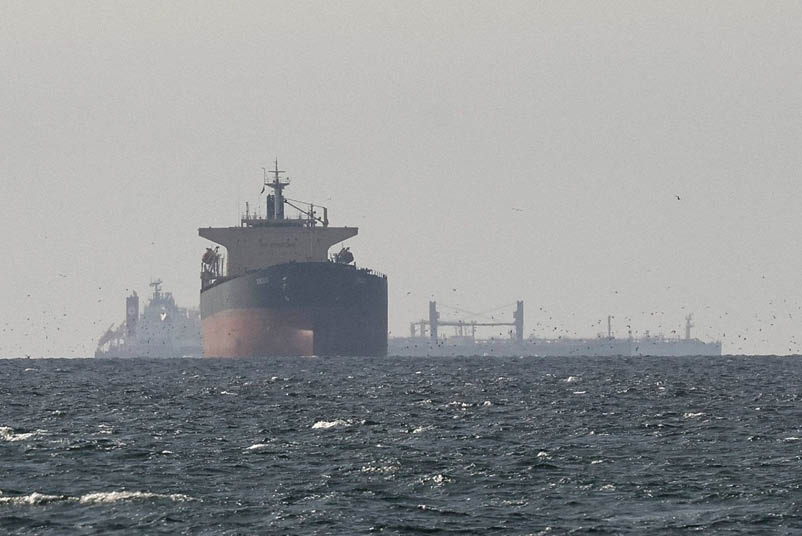
ISLAMABAD: Crude oil prices edged lower on Thursday, undermined by heightened uncertainty over demand prospects, rising crude oil inventories in the United States and OPEC+ infighting. As of 1345 hours GMT, Brent, the international benchmark for two-thirds of the world’s oil, shed $0.36 (-0.50 percent) to reach $72.24. The West Texas Intermediate (WTI), the main oil benchmark for North America, went down by $0.22 (-0.32 percent) to $67.87. TLTP
The price of Russian Sokol decreased by $0.62 (-0.99 percent) to $61.91. Arab Light prices witnessed a decrease of $1.02 (-1.36 percent) to reach $73.72 a barrel.
The price for Opec Basket decreased by $1.69 (-2.20 percent) to $75.19. The OPEC Reference Basket of Crudes (ORB) is made up of Saharan Blend, Girassol, Djeno, Zafiro, Rabi Light, Iran Heavy, Basra Light, Kuwait Export, Es Sider, Bonny Light, Arab Light, Murban and Merey.
While the removal of China’s coronavirus restrictions earlier in the year was seen as a game changer for fossil fuels, the reopening of the Asian economy has fallen short of expectations, with economic activity flattening out in recent weeks.
Crude oil inventories in the United rose this week by 5.202 million barrels, the American Petroleum Institute (API) data showed, with analysts expecting a 1.22 million barrel dip. The rise in crude oil inventories doesn’t fully offset the 6+ million barrel drop last week.
Swelling supplies from Russia also appears to be weighing on the commodity. Although OPEC+ slashed output a couple of months ago, Russia has continued to pump huge volumes of crude in an effort to maximise its revenues, reneging on its promise to throttle production.
The OPEC+ internal strife may prevent the cartel from further reducing quotas at the June meeting, as many members may voice opposition to such a move given recent developments. This situation may keep physical markets in surplus during the second half of 2023, especially if the global economy takes a turn to the downside.
The OPEC+ member states are sending mixed signals before their meeting this Sunday and this is keeping the oil markets on the edge. The oil companies have been restarting operations amid slowing wildfires in Canada’s most oil-prolific province Alberta, with at least 90,000 barrels per day of the 400,000 barrels per day of previously shut-in production now back.