ISLAMABAD
Crude oil prices were steady on Thursday as the announcement of a coalition to protect ships from Houthi attacks calmed investors.
As of 1215 hours GMT, Brent, the international benchmark for two-thirds of the world’s oil, shed $0.35 (-0.44 percent) to reach $79.35 a barrel. The West Texas Intermediate (WTI), the main oil benchmark for North America, went down by $0.32 (-0.43 percent) to $73.90 a barrel. Brent rose by $0.71 on WoW last week while WTI closed last week higher by $0.20.
However, the price of Russian Sokol increased by $0.10 (+0.14 percent) to $73.62. Arab Light prices witnessed an increase of $0.07 (+0.09 percent) to reach $82.26 a barrel. On the other hand, the price for Opec Basket went up to $79.19 a barrel with an increase of $0.72 (+0.92 percent). The OPEC Reference Basket of Crudes (ORB) is made up of Saharan Blend, Girassol, Djeno, Zafiro, Rabi Light, Iran Heavy, Basra Light, Kuwait Export, Es Sider, Bonny Light, Arab Light, Murban and Merey.
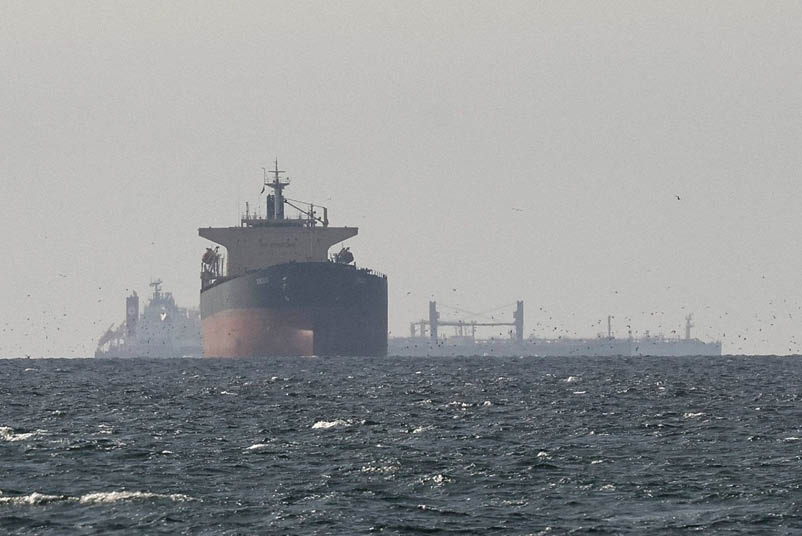
Several countries, led by the US, agreed on Monday to jointly carry out patrols in the southern Red Sea and Gulf of Aden to safeguard commercial shipping after many companies decided to halt their operations in the region. Some of the world’s largest shipping companies suspended their operations in the Red Sea after attacks by Yemeni Houthi rebels.
Greece advised commercial vessels sailing in the Red Sea and the Gulf of Aden on Wednesday to avoid Yemeni waters.
The Bab El Mandeb, situated at the southern edge of the Red Sea and the western part of the Gulf of Aden, serves as a vital route for oil tankers and vessels travelling between the Arabian Gulf and Asia, as well to Europe by way of the Suez Canal. About 12 percent of the seaborne oil trade and 8 percent of liquefied natural gas pass through the strait.
Greek ship-owners control about 20 percent of the world’s commercial vessels in terms of carrying capacity.
Earlier this week, one of the largest tanker companies, Maersk Tankers, told its fuel carrier crews that they can bypass the Red Sea from now amid a series of missile and drone attacks on vessels in the area from the Yemeni coast. If carriers choose to bypass the Red Sea, it will also bypass the Suez Canal and add thousands of miles to their journeys, opting to sail around Africa instead.
Similarly, BP said on Monday that it has temporarily paused all transits through the Red Sea, following attacks over the weekend by Houthi forces which control most of Yemen. Other shipping firms said over the weekend that they would avoid the Suez Canal.