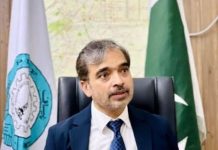
ISLAMABAD: The Institute of Regional Studies (IRS) hosted a seminar titled “Advancing Pakistan’s Regional Trade in an Evolving Geopolitical Landscape,” bringing together trade officials, business leaders and policymakers to explore ways of leveraging Pakistan’s strategic geography to expand regional commerce. Speaking at the seminar, Ambassador Jauhar Saleem, President IRS, noted that regional trade accounts for just over 10 percent of Pakistan’s total external trade, compared with 26 percent for ASEAN and 52 percent for NAFTA. DNA
He said this gap reflected Pakistan’s underutilized geographical and economic potential, particularly in relation to Afghanistan, Central Asia, Iran and other neighbouring markets.
Ambassador Saleem observed that Pakistan’s trade with Central Asia remained below $500 million despite the region’s population of approximately 75 million. He stressed that geography alone does not create trade; connectivity, effective agreements, functioning financial channels and policy continuity do.
He said CPEC’s next phase should place greater emphasis on regional connectivity, trade, logistics and export-oriented investment. Pakistan, he added, should seek to position itself as a commercial bridge linking China and South Asia with Central Asia, Afghanistan, Iran and the wider Middle East.
Highlighting Pakistan’s approximately 11-million-strong diaspora and record remittances of $41.6 billion during the year, Ambassador Saleem said the diaspora should be viewed not only as a source of remittances but also as a bridge to markets, investment, technology and global business networks.
He called for regional trade to be made an integral part of Pakistan’s economic and foreign policy and said that, with sustained political commitment, better infrastructure, effective implementation of existing agreements and improved trade facilitation, Pakistan could raise the share of regional trade to 20–30 percent of its total external trade over the medium term.
Usman Shaukat, President of the Rawalpindi Chamber of Commerce and Industry (RCCI), observed that the global order was becoming increasingly multipolar, with economic strength a key determinant of influence. Referring to the 2026 US-Israel-Iran conflict and the ensuing oil crisis, he highlighted Pakistan’s potential role as a mediator and stressed that diplomatic engagement should also yield economic dividends. He called for an integrated approach to CPEC, Gwadar Port and the TAPI gas pipeline.
Muhammad Naseer, Chief Executive of the Pakistan Horticulture Development and Export Company and former Senior Director General at TDAP, noted that Pakistan’s combined trade with Afghanistan, Iran, India and Central Asia was only $2.45 billion during the last fiscal year, less than one-tenth of its trade with China.
He said exports to Afghanistan had declined by 74 percent in one year, while trade with Iran remained constrained by the absence of a banking channel despite a finalized free trade agreement. He identified Central Asia as a positive exception, where Pakistan maintains a trade surplus, and called for stronger implementation of existing trade agreements and targeted measures to expand exports, particularly in agriculture and horticulture.
He also emphasized that realizing Pakistan’s regional trade potential would require institutional coordination, improved trade facilitation, reliable financial mechanisms and consistent policy implementation .