SAMARKAND
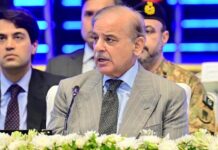
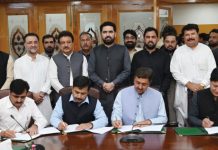
On the sidelines of the Shanghai Cooperation Organization (SCO) summit in Samarkand, Prime Minister Shehbaz Sharif held meetings with some of the leaders of the grouping and apprised them of the situation in the flood-ravaged country and vowed cooperation in key sectors like trade and investment.
In a tween on Friday, Prime Minister Shehbaz said that in his meetings with leaders of friendly countries, they agreed on enhancing trade and investment. He said that he explained to them the flood ravages due to climate change adding that food and energy shortages presented a real challenge to the shared development agenda.
“It was a long but productive day in Samarkand. In my meetings with leaders of our friendly countries, we agreed on enhancing trade and investment. I explained the flood ravages due to climate change. Food and energy shortages present a real challenge to our shared development agenda,” the Prime Minister wrote on the twitter.
As per details, Prime Minister Shehbaz Sharif Friday met with President of Azerbaijan Ilham Aliyev on the sidelines of SCO-CHS Summit in Samarqand, Uzbekistan and discussed issues of bilateral interests.
The meeting between the two leaders which was held in the historic city of Samarkand focused on ways to strengthen relationship between the two countries in diverse fields. Foreign Minister Bilawal Bhutto Zardari, Defence Minister Khawaja Asif, Finance Minister Miftah Ismail and senior officials also attended the meeting.
Prime Minister Shehbaz Sharif also held a meeting with Turkish President Recep Tayyip Erdogan on the sidelines of SCO Summit in Samarkand on Friday. Both the leaders decided to continue high-level exchanges to further enhance the multi-dimensional strategic relations between the two countries.
The Prime Minister extended his gratitude to President Erdogan and to the people of Turkiye for their solidarity and generous support in the wake of devastating floods in Pakistan, caused by climate change.
Highlighting close fraternal ties between the two countries, the Prime Minister underscored the importance of various bilateral institutional mechanisms, in particular the High-level Strategic Cooperation Council, which serves as the leadership-level platform to provide strategic direction to this abiding partnership.
While welcoming the recent signing of “Trade in Goods” agreement between both countries, the Prime Minister expressed the confidence that optimal utilization of the agreement would boost bilateral trade and act as a catalyst in further cementing bilateral economic and investment relations.
Russian President Vladimir Putin hailed the growing influence of “new centres of power” on Friday at a summit with Asian leaders including China’s Xi Jinping. b”The growing role of new centres of power who cooperate with each other… is becoming more and more clear,” Putin told the meeting of the Shanghai Cooperation Organisation (SCO) in ex-Soviet Uzbekistan. “We are open to cooperation with the entire world,” Putin said.
“Our policy is devoid of any selfishness. We hope others… will carry out their policies according to the same principles, and will stop using the instruments of protectionism, illegal sanctions and economic selfishness,” Putin said.
The summit has brought together Putin and Xi with the leaders of several Asian countries including India and Pakistan, as Russia looks to show it has not been fully isolated by the conflict in Ukraine.
China’s President Xi Jinping on Friday called for regional countries to reshape the international order at a summit in Uzbekistan touted as a challenge to Western global influence.
Leaders should “work together to promote the development of the international order in a more just and rational direction”, Xi said at a meeting of the Shanghai Cooperation Organisation including the leaders of Russia, Iran and central Asian countries.
Xi told the summit that members should “abandon zero-sum games and bloc politics,” as well as “uphold the international system with the United Nations at its core.”
Turkish President Recep Tayyip Erdogan on Friday told a regional summit attended by Russian counterpart Vladimir Putin that he wanted the war in Ukraine to end “as soon as possible”.
Erdogan has been trying to use his good working relations with Moscow to try and persuade Putin to hold direct ceasefire talks with Ukrainian President Volodymyr Zelensky in Turkey.
He told a meeting of the Shanghai Cooperation Organisation in ex-Soviet Uzbekistan that Turkey was making diplomatic efforts to end the war. “We are making efforts to finalise the conflict in Ukraine through diplomacy as soon as possible,” Erdogan said.
Erdogan also echoed Putin’s concern that grain shipped out of Ukraine under a UN and Turkish-brokered agreement was not reaching enough developing countries. “We are making sincere efforts to deliver the grain to those who need it most, especially our brothers and sisters in Africa,” Erdogan said.
Erdogan was due to hold a private meeting with Putin on the sidelines of the Samarkand summit later Friday. NATO member Turkey has been supplying weapons to Ukraine while trying to boost trade with Russia during the war. Erdogan argues that this “balanced” position is required because of Turkey’s heavy dependence on Russian energy supplies.
The SCO currently comprises eight Member States (China, India, Kazakhstan, Kyrgyzstan, Russia, Pakistan, Tajikistan and Uzbekistan), four Observer States interested in acceding to full membership (Afghanistan, Belarus, Iran, and Mongolia) and six “Dialogue Partners” (Armenia, Azerbaijan, Cambodia, Nepal, Sri Lanka and Turkey).
The Shanghai Five, formed in 1996, became the Shanghai Cooperation Organisation (SCO) in 2001 with the inclusion of Uzbekistan. With India and Pakistan entering the grouping in 2017 and the decision to admit Tehran as a full member in 2021, SCO became one of the largest multilateral organisations, accounting for nearly 30 per cent of the global GDP and 40 per cent of the world’s population.