ISLAMABAD
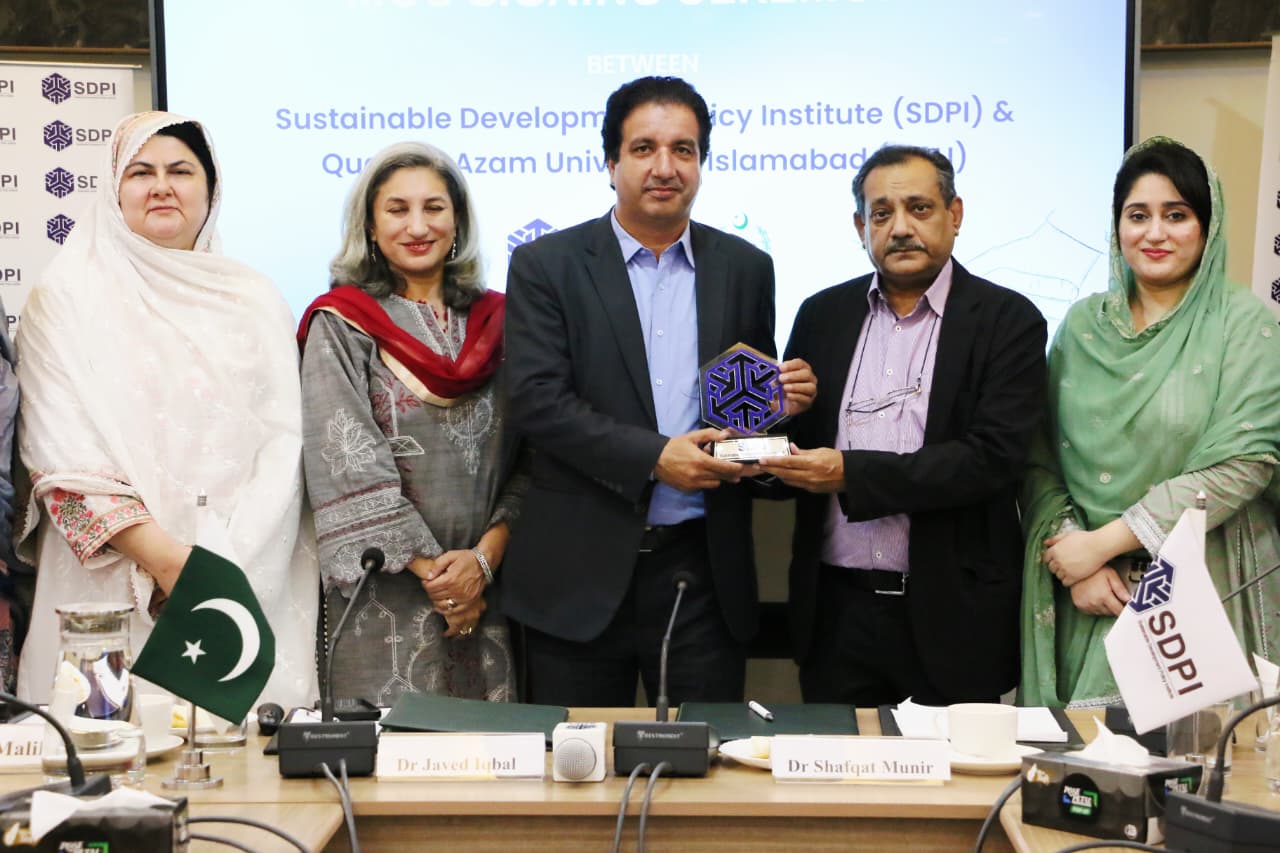
The Sustainable Development Policy Institute (SDPI) and Quaid-i-Azam University (QAU) have signed a Memorandum of Understanding (MoU) aimed at deepening academic-policy collaboration in research, capacity building, and knowledge exchange.
SDPI, QAU sign MoU to strengthen research, policy collaboration.
The agreement was formally signed by Dr. Shafqat Munir, Deputy Executive Director (Policy) at SDPI, and the Head of QAU’s School of Economics, marking a new chapter in the longstanding relationship between the two institutions, said a press release issued on Saturday.
Speaking at the signing ceremony, Dr. Shafqat Munir welcomed the collaboration, calling it a significant and special occasion.
He recalled the enduring ties between SDPI and Quaid-i-Azam University, noting that both institutions enjoy strong standing at the national level. Drawing on his personal experience as both a student and teacher at QAU, he described the university as a “mini Pakistan,” representative of the country’s diversity.
He also noted SDPI’s growing stature as a leading think tank not only in Pakistan but across the Asia-Pacific region and globally.
Dr. Munir underlined the importance of expanding cooperation between the two institutions, particularly in research, policy development, and knowledge exchange.
He praised QAU’s contributions in economics, political science, and international affairs, and said the partnership had strong potential to bridge the gap between academic research and practical policymaking. He expressed hope that the MoU would help deepen the historic friendship and cooperation between SDPI and the university.
He also shared that SDPI has been elected, for the third consecutive time, as chair of the South Asia Climate Action Network, part of the wider Climate Action Network International, a reflection, he said, of the institute’s growing regional and global influence.
During the ceremony, SDPI’s Head of Ecological Sustainability and Circular Economy, Zainab Naeem briefed the visiting QAU delegation on the institute’s role, mission, and vision since its founding as an independent think tank. She outlined SDPI’s three core areas of work, research, advocacy, and capacity building, spanning policy advisory services, evidence-based research, public education, and local-to-global dialogue platforms. She also highlighted SDTV, Pakistan’s first digital platform of its kind, along with the institute’s international partnerships.
Ms. Naeem detailed SDPI’s key research themes, including environment and climate change, resilience and systems analysis, and economic growth and development. She spoke about specialized units such as the Centre for Evidence and Policy Research, the Centre for Learning and Development, and the Network for Clean Energy Transition, as well as data initiatives including Data for Development, the Alif Ailaan Data Repository, and the Sub-national Level Resource Mobilization (SLRM) programme.