By Dr Muhammad Shahid
ISLAMABAD: On the broad, tree-lined avenues of Pakistan’s capital, a quiet shift is taking place. The familiar rumble of diesel engines and the puff of exhaust smoke are gradually being replaced by a silent hum.
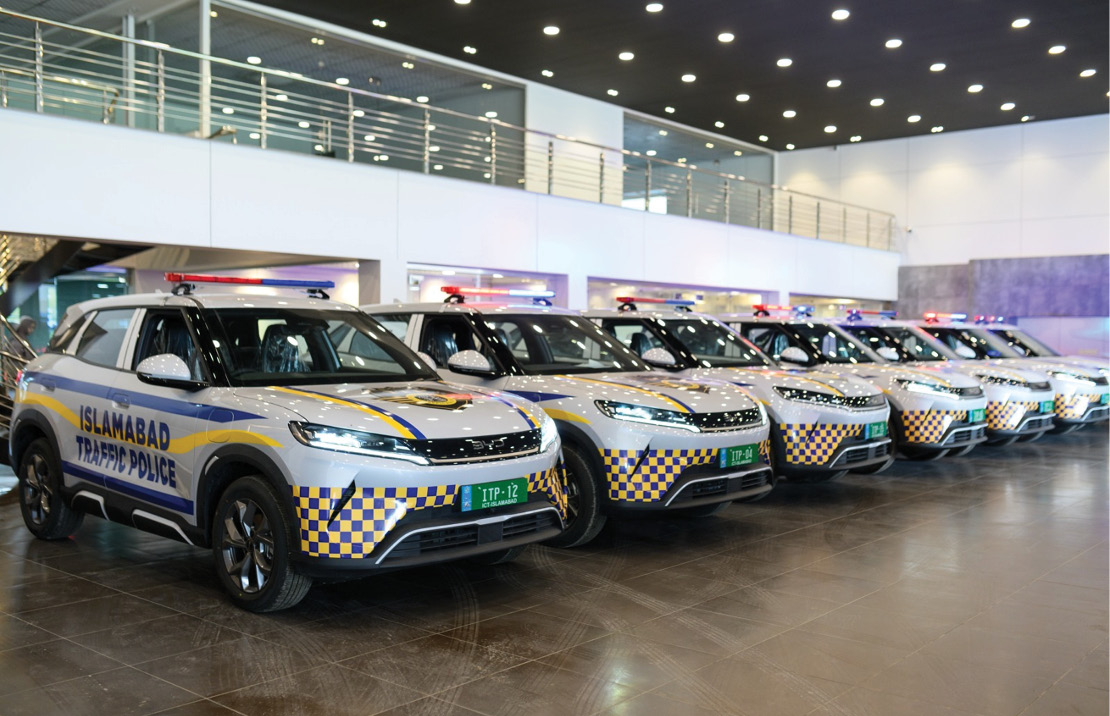
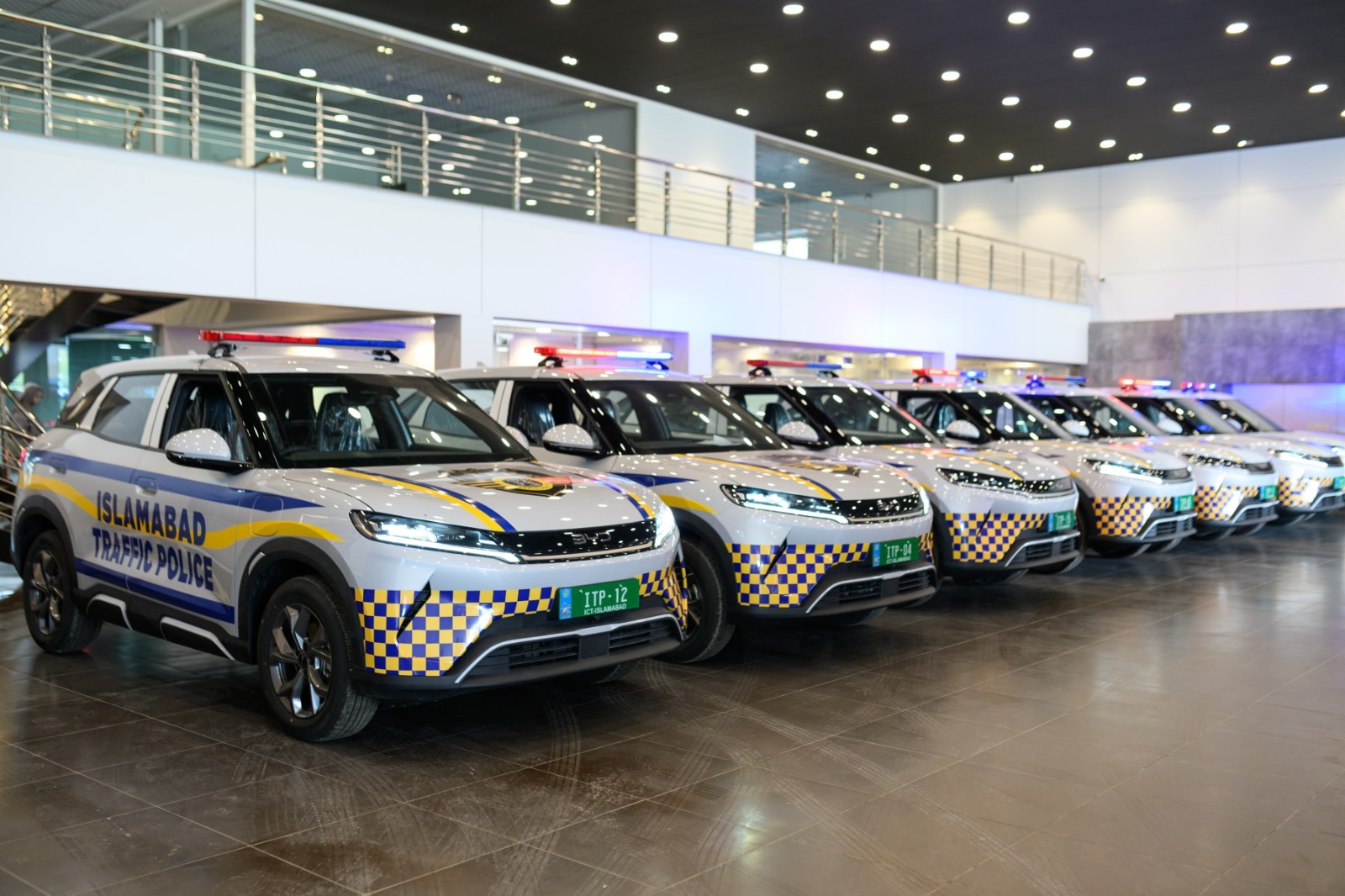
In a major step toward modernising its public infrastructure, the Islamabad Police is rapidly expanding its transition to electric mobility. According to sources, the department has inducted roughly 80 BYD electric vehicles (EVs) into its Capital Patrol Unit (CPU), including 40 for the traffic police alone.
The chief of Safe City Project and DIG Traffic, Muhammad Haroon Joya, told the Lead Pakistan that 40 of these modern electric vehicles have been handed over to the traffic police.
“Work is in progress on solar power stations for these cars, which are fast, require minimal power, and are best for urban mobility,” he said, “We, the Islamabad Police, not only are saving people’s lives as part of our policing responsibility but also saving environment.”
From trial to mainstream
This fresh batch of silent cruisers brings the city’s total electric law enforcement fleet to approximately 120 vehicles. It is a transition that positions Islamabad as the operator of one of the largest electric police fleets in South Asia.
This is not a sudden experiment. The expansion follows a successful pilot when the Islamabad Traffic Police (ITP) rolled out 40 BYD electric SUVs—specifically the Atto 2 and Sealion 7 models.
Initially tested along major corridors and high-density commercial zones, the vehicles proved their worth almost immediately. According to local department data, the test runs recorded a stellar 97.7% satisfaction rate, with operational costs projected to recover the initial purchase price in roughly 11 to 14 months.
The newly added 80 vehicles are headed straight to the Capital Patrol Unit (CPU). While the traffic police manage the intersections and flow of the city, the CPU has a wider, more urgent remit. They are tasked with highway patrolling, rapid emergency response, crime prevention, and maintaining a highly visible deterrent on the major arterial roads connecting Islamabad.
Overcoming the power hurdle: the infrastructure backbone
For any electric vehicle fleet, the vehicles themselves are only half the equation. The real test of viability lies in the power grid and the charging network—a particularly sharp concern in Pakistan, where energy security is a frequent public talking point.
To keep these patrol cars moving, the department has integrated a dedicated fast-charging infrastructure. During the initial rollout phases, a network of specialized docking stations was established specifically to support police operations. These stations are strategically mapped out across main corridors, urban centers, and commercial hubs to ensure that a patrol car is never too far from a power source.
These fast-charging docks can replenish a patrol vehicle’s battery from empty to near-full in 60 to 90 minutes, allowing for minimal downtime between shifts. When the immediate rush of patrol duties is over, vehicles can also undergo a standard 6 to 8-hour charge at local precinct bays during off-peak night hours.
With each full charge, the patrol units can cover a distance of 350 to 400 kilometres. This range comfortably covers a full-day urban shift without the anxiety of losing power mid-patrol. At the same time, the broader charging landscape is expanding. Under a joint venture between BYD, Hubco Green Energy, and Pakistan State Oil (PSO), public fast-charging points have opened in busy commercial hubs like I-8 Markaz and E-11, laying down the early foundations of a city-wide public EV grid.
Modernising the ranks
The greening of the capital’s police force extends beyond standard patrols. Higher up the chain of command, Sub-Divisional Police Officers (SDPOs) are already supervising their zones in BYD Shark plug-in hybrid double-cabin pickup trucks. Locally referred to as “Radera” vehicles, these rugged hybrids allow field command officers to conduct inspections and coordinate tactical operations with the same modern, fuel-efficient technology as the street patrols.
For officers on the ground, the transition is more than just an environmental statement; it is a practical upgrade: one, the electric drivetrains operate almost silently, a major tactical advantage during nighttime neighborhood patrols; secondly, unlike conventional combustion engines that require time to build revs, electric motors provide instant torque, crucial for rapid response and pursuits; and thirdly, compared with traditional petrol-powered vehicles, the department projects that each electric patrol car saves up to 550,000 rupees per month in fuel and maintenance costs.
A global pivot to cleaner patrols
Islamabad’s initiative is part of a much broader, global momentum. Globally, the shift toward electric law enforcement has been picking up speed as we have the examples of China, UAE and other countries. China remains the undisputed leader, with megacities like Shenzhen, Beijing, and Shanghai utilizing thousands of electric patrol cars. India has integrated home-grown options like the Tata Nexon EV into several of its municipal police fleets. Major capitals from Singapore to the UAE are rapidly phasing out combustion engines to meet strict urban emission goals.
For Pakistan, however, the incentive is as much about economics as it is about clean air. Amid fluctuating global oil prices and pressure on foreign exchange reserves, reducing the state’s reliance on imported fuel is a high priority. If the quiet experiment playing out on the streets of Islamabad is any indication, the future of policing in Pakistan may very well be electric.
Note: Muhammad Shahid is a freelance journalist based in Islamabad.