For the best part of 48 hours, first the defence secretary and then the foreign secretary were struggling to cogently articulate in public what the government made of the US and Israel’s attacks on Iran and why.
But in the Commons the prime minister directly and explicitly set out his view, when he told MPs the government “does not believe in regime change from the skies”.
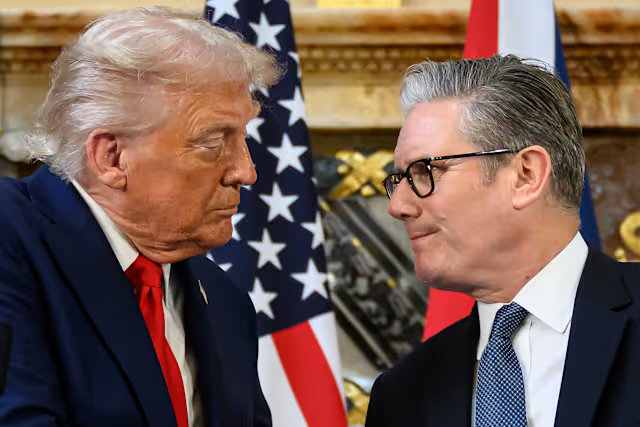
He was also explicit in acknowledging his disagreement with President Donald Trump – perhaps his biggest and most consequential such disagreement yet.
The memory of the Iraq war was referred to repeatedly across the chamber, including by the Prime Minister.
A conflict that happened more than a decade before he became an MP and more than two decades before he arrived in Downing Street was key to the case he made for his outlook now.
Sir Keir Starmer took questions from MPs for around two-and-a-half hours, spelling out that he thought the American and Israeli actions were not right and implying they were not lawful either – but that it was both right and lawful to authorise the US to use UK airbases to bomb Iranian missile launch sites, in order to protect British allies in the Gulf from attack.
There is, without question, an argument about what would be lawful. For the Conservatives, shadow attorney general Lord Wolfson has set out why he believes UK involvement could be argued to be within international law.
But the prime minister disagrees and his instinct on the importance of acting lawfully was made abundantly clear – a position we shouldn’t be surprised about given he is a former senior lawyer.
Most Labour MPs appear broadly comfortable with Sir Keir’s judgement, as he faces criticism from both left and right.
The Conservatives and Reform UK say the UK should have been much more explicit in its support for allies the US and Israel. The Liberal Democrats, Green Party and Scottish National Party are, to varying degrees, more critical of President Trump.
An opinion poll by YouGov suggests far more people in Britain oppose the US’s actions than support them and far more oppose the UK allowing the US to use British airbases than support that decision.