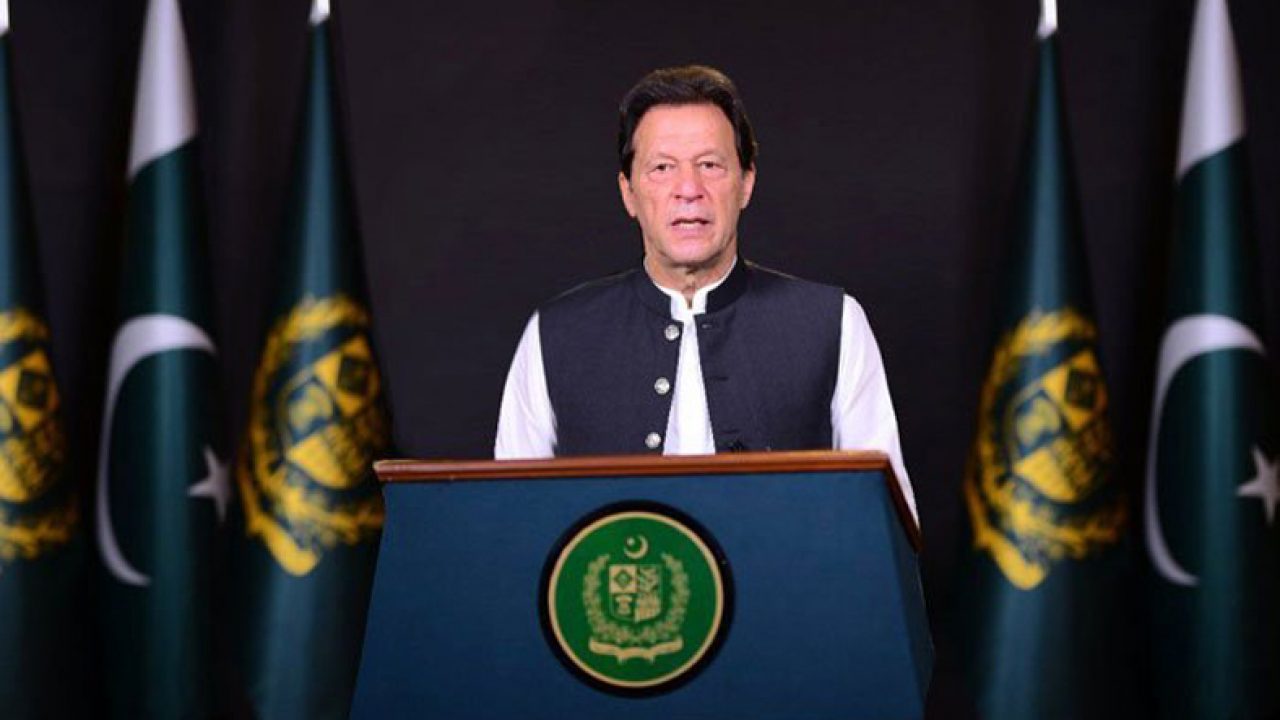
Prime Minister (PM) Imran Khan on Monday has said that corruption is a sign of non-rule of law, failure to follow the rule of law breeds corruption, supremacy of law strengthens democracy in the country.
Prime Minister Imran khan said that Pakistan had not been credited by western countries for the sacrifices made during the decades-long global war on terror.
Addressing the Margalla Dialogue 21 ceremony in Islamabad, he said that no other country in the history of the United States has made such a great sacrifice. Pakistan faced the biggest collateral damage in the Afghan war as it is the only country in the US’s alliance which suffered more than 80 thousands casualties, displacement of millions of people and over 100 billion rupees loss to the economy.
He regretted that Muslims in the West had to face hardships but there was no response from the Islamic world’s leadership.
Imran also regretted that Pakistan was not able to effectively present its point of view before the world.
Referring to national security Prime Minister Imran Khan said that national security was more than just a matter of focusing on military might, adding that it encompassed inclusive growth as well.
“We all know our focus was on military (power) but it (national security) is actually an all-encompassing thing. You can’t have national security until there is inclusive growth,” PM added.
He said sans inclusive growth, inequality becomes the basis of discord in society. “It is a very important issue of national security that how can we have equitable and inclusive development.”
“Unequal distribution of resources leads to anarchy among the people who are left out of the mainstream development,” he said. “The uplift of the underprivileged segment of the society was critical to ensure across the board national security.” PM added.
On Islamophobia, the PM said, a strong response by Muslim think tanks was important to nullify the impression of Islam’s linkage with terrorism.
“The racist government in India is pursuing fascist policies against minorities including in Indian Illegally Occupied Jammu and Kashmir,” Imran said referring to New Delhi, adding that western countries do not criticize the illegal occupation.
The premier hoped that more think tanks would be established in Pakistan that competed with each other in quality of research and global credibility. “Then we will be able to properly put our national narrative in front of people,” he said.
He lamented that since the Salman Rushdie affair, foreign media and think tanks concentrated on Pakistan’s extremes and generalised the whole society. “If you concentrate on any society’s extremes then you will say a lot of bad things about it,” he added.
He held the “unjust” three-tiered education system as being majorly responsible for the extremes in Pakistani society since it produced three groups that had no connection with each other.
“I expect that now the time has come to research, bring original thought and define our country instead of someone from outside doing it. The more the credibility of your think tanks increases, the easier it will be for us to define ourselves in the world.”
The prime minister said a similar focus was needed on human development as well and called upon the audience to highlight the issues in Pakistan’s three-tiered education system.
He lamented that three education systems were running in parallel in the country with English-medium, Urdu-medium and religious schools. “Do we think there will be no fallout of this?” he asked.
He pointed out that English-medium schools were subject to further segmentation, while Urdu-medium schools had seen a decline in quality and there was a lack of job opportunities for students of religious schools.
Prime Minister Imran attributed the above imbalance to lack of research in the country and reliance on second-hand research from abroad. “This is why it is important to have an all-encompassing national security dialogue,” he stressed.