Switzerland records worst decade of ice melt, loses one quarter glacier volume since 2015
Zürich
Switzerland’s glaciers melted considerably over the past 12 months to log their fourth-largest reduction in ice volume on record, monitoring body GLAMOS said on Wednesday.
A winter with little snow, especially in the northeastern part of the Swiss Alps, followed by heat waves in June, caused the glaciers to lose 3% of their total ice mass, according to this year’s report by GLAMOS and the Swiss Commission for Cryosphere Observation.
“This is really a lot,” said Matthias Huss, the director of GLAMOS, whose reports cover the October-September hydrological year.
Although the ice melt was not as extreme as in 2022 and 2023, when the glaciers lost 5.9% and 4.4% respectively, the trend is clear.
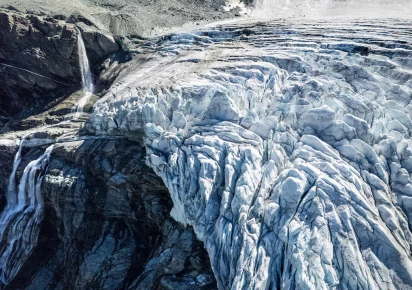
Switzerland has had its worst decade of ice melt on record, with one quarter of glacier volume lost since 2015, Huss added, speaking with Reuters during a visit to the Rhone Glacier in Valais canton.
The Rhone Glacier was the biggest glacier in Europe during the Ice Age, but has rapidly shrunk, losing on average about 1.5 meters in thickness this year.
According to GLAMOS, about one hundred glaciers in Switzerland have vanished between 2016 and 2022, and it says that most could disappear by the end of the century.
“Unfortunately, there is not much we can do to save the glaciers … They will continue retreating anyway, even if the climate is stabilised today,” said Huss.