‘We have a plan to escalate if necessary. We have a plan to retrograde if necessary,’ US defence chief says
Washington
United States Defence Secretary Pete Hegseth said on Tuesday that a ceasefire between the US and Iran was active, even as lawmakers pressed him on whether a formal written agreement existed between the two sides.
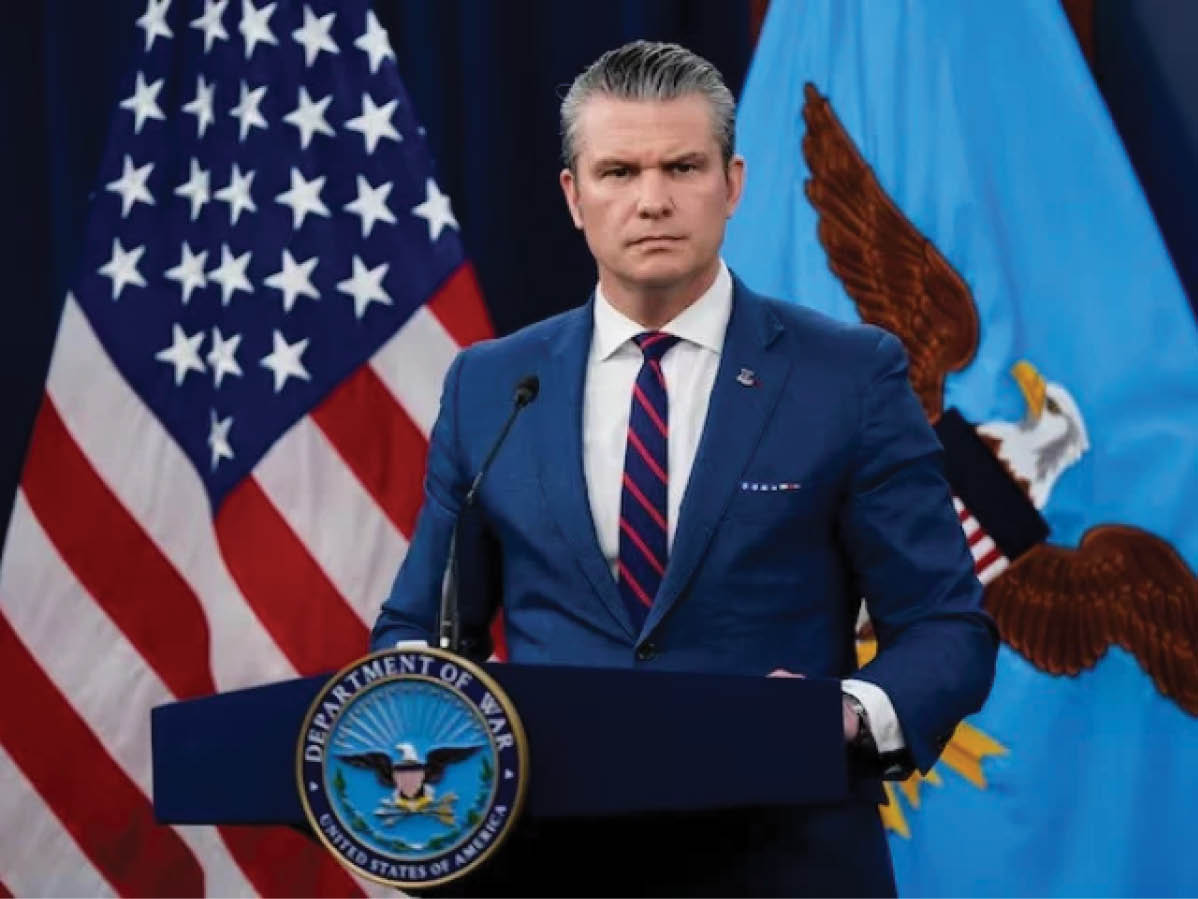
Hegseth made the remarks alongside Joint Chiefs of Staff Chair General Dan Caine during testimony before a House Appropriations subcommittee reviewing the Trump administration’s proposed 2027 defence budget, and discussing developments in the conflict with Iran.
The sharpest exchange came when Representative Pete Aguilar questioned Hegseth about last month’s testimony in which the Pentagon chief said the ceasefire effectively paused the 60-day clock under the War Powers Resolution.
“Who were the parties to the ceasefire?” Aguilar asked. “Well, right now we are in that same ceasefire, as of right now,” Hegseth replied. Aguilar interrupted, saying, “That wasn’t the question. Who are the parties to the ceasefire?” “That would be the United States and the regime in Iran,” Hegseth responded.
The Democrat from the state of California then pressed for details on the agreement, asking whether the ceasefire had written terms or formal documentation.
“How many pages is the ceasefire? What deal points? How do we know that the ceasefire is active or not active without any documentation?” Aguilar asked. “We know,” Hegseth said. “It’s evident, and the ceasefire is in effect.” Aguilar continued questioning whether lawmakers were simply expected to trust the administration’s assessment without seeing a formal framework. “You just trust that the president knows that the ceasefire is active or not inactive?” Aguilar asked. “As you know, for the most part, a ceasefire means the fire is ceasing, and we know that has occurred while negotiations occur,” Hegseth replied. The US and Israel launched strikes against Iran on February 28, triggering retaliation from Tehran against Israel as well as US allies in the Gulf, along with the closure of the Strait of Hormuz.
A ceasefire took effect on April 8 through Pakistani mediation, but talks in Islamabad failed to produce a lasting agreement. The truce was later extended by Trump without a set deadline.
Earlier in the hearing, Hegseth defended the administration’s broader military posture and the proposed $1.5 trillion defence budget, calling it “a fiscally responsible budget” and “a war-fighting budget”. “We are rebuilding a military that the American people can be proud of,” Hegseth said. “One that instils nothing less than the unrelenting fear in our adversaries and confidence in our allies. We fight to win in every scenario.”
The defence secretary also argued that concerns about US weapons stockpiles had been exaggerated after committee chairman Ken Calvert raised questions about munitions spending and replenishment needs tied to the ongoing operation.
“The munitions issue has been foolishly and unhealthily overstated,” said Hegseth. “We know exactly what we have. We have plenty of what we need.”
Representative Betty McCollum later asked whether the Pentagon had contingency plans should the ceasefire collapse.
“We have a plan for all of that,” said Hegseth. “We have a plan to escalate if necessary. We have a plan to retrograde if necessary. We have a plan to shift assets.”
He declined to provide operational specifics publicly, citing the sensitivity of the mission and the administration’s objective “to ensure that Iran never has a nuclear bomb”.
US war in Iran has cost $29b so far, says Pentagon
A senior Pentagon official earlier said the war in Iran has cost $29 billion so far, an increase of $4b from an estimate provided late last month.
With just six months before the midterm elections in which US President Donald Trump’s Republicans may face an uphill battle to keep their House majority, Democrats are riding high in public opinion polls as they attempt to link the war with cost-of-living issues.
On April 29, the Pentagon said the war at that point had cost $25b.
Jules Hurst, who is performing the duties of the comptroller, told lawmakers that the new cost included updated repair and replacement of equipment and operational costs.
“The joint staff team and the comptroller team are constantly looking at that estimate,” Hurst said. He was speaking alongside Hegseth and General Caine.
Iran now defines Strait of Hormuz as far larger zone, IRGC officer says
Iran has expanded its definition of the Strait of Hormuz into a “vast operational area” far wider than before the Iran war, according to a senior officer in the Islamic Revolutionary Guard Corps (IRGC) Navy.
The strait is no longer viewed as a narrow stretch around a handful of islands but instead has been greatly enlarged in scope and military significance, said Mohammad Akbarzadeh, deputy political director of the IRGC Navy, the state-affiliated Fars news agency reported on Tuesday.
“In the past, the Strait of Hormuz was defined as a limited area around islands such as Hormuz and Hengam, but today this view has changed,” Akbarzadeh said.
About a fifth of the world’s oil and liquefied natural gas supply normally passes through the strait, which is the gateway to the Gulf and main export route for countries such as Saudi Arabia, Iraq and Qatar.
Akbarzadeh said the strait is now defined as a strategic zone stretching from the city of Jask in the east to Siri Island in the west, describing it as “a vast operational area”.
The reported expansion is the second announced by Iran since the start of its conflict with the US and Israel.
On May 4, the IRGC Navy published a map showing a new zone of control extending along significant a stretch of the UAE’s Gulf of Oman coastline.
That stretched from Iran’s Mount Mobarak and the UAE’s emirate of Fujairah in the east to Iran’s Qeshm Island and the UAE emirate of Umm al Quwain in the west.
Tuesday’s announcement appears to represent a widening of that area.
Fars and Tasnim, another Iranian news agency, reported on Tuesday that the strait’s width, which they said was previously estimated at 20 to 30 miles, had now increased to between 200 and 300 miles. The expanded zone forms a “complete crescent”, Tasnim said.