Rear Admiral (retd) Faisal Shah
The US National Security Strategy 2025, premised on “America First,” has one of the core objectives of preventing an adversarial power from dominating the Middle East, its oil and gas supplies, and the chokepoints through which they pass, while avoiding the “forever wars” that bogged the US down in that region at great cost. Without naming, the adversarial power is obviously Iran. If the slogan of “America First” is to be kept in mind, one wonders which US interests in the region Iran is hurting directly, that have caused the US to act against it? As a matter of fact, the US wishes to retain its political, economic and military influence in the region as the petrodollar is essential for its economy. The influence is also necessary to safeguard Israel’s existence. These are the ends. The ways of achieving it is portraying Iran as a nuisance in the region, while the means are political, economic and military levers that the US enjoys being a Superpower. It therefore maintains a permanent presence through military bases on at least nineteen sites in the region. Iran is not hurting any US interest directly but in fact helps US to pursue its objectives. In other words, the US needs a thriving Iran enough to radiate threat to all the countries in the region. It also helps US Military Industrial Complex, contributing 3.5 percent to its GDP, to receive massive orders from the regional countries. Obviously, the US equipment is not intended to be used against Israel.
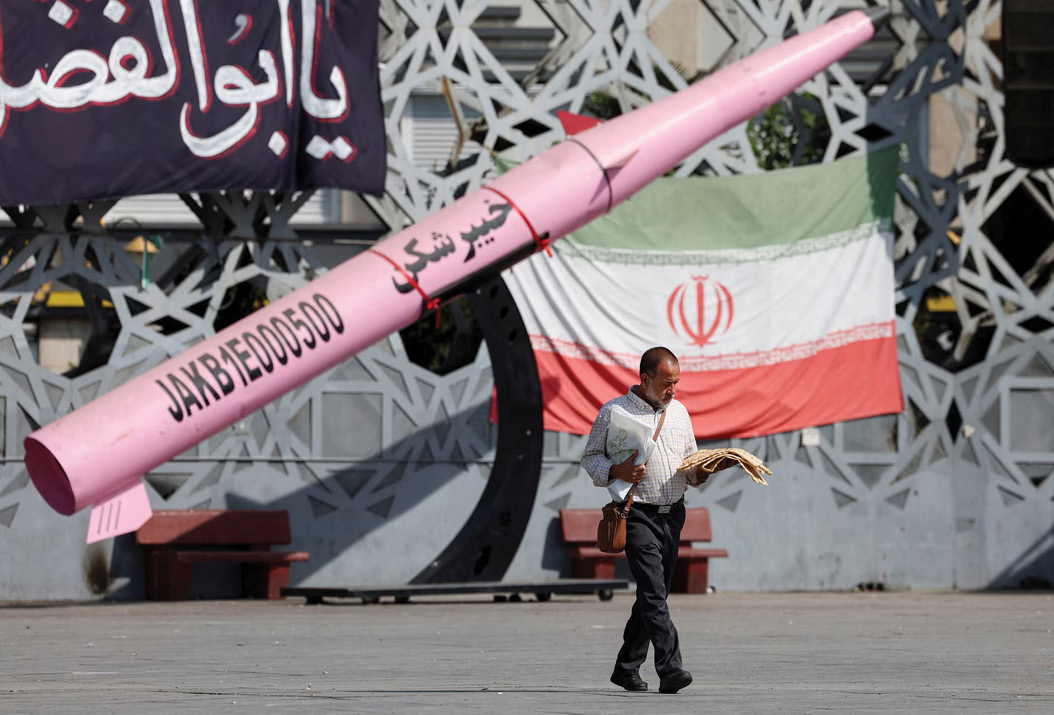
Under the current circumstances, when the protests in Iran have been quashed by the government, there is no pretext under which the US may attack Iran to help the protestors. However, the US and Israel’s long-standing demand from Iran for abolishing nuclear enrichment altogether, limiting the ballistic missiles program and cutting off support to its proxies is still pending, for which Iran is to be pressured. Iran is ready to negotiate on table on equal terms for its rightful allowance for the nuclear enrichment being a member of NPT, its security needs and a justifiable resolution of the Palestine issue. It is also ready for a military confrontation should it be imposed on the country. Being weaker in defence than the combined US and Israeli might, how Iran is going to respond to such a situation is a question that needs attention.
Iran’s geography is quite unique. It’s double the size of Pakistan with less than half the population. Population centres are sparsely located. Although its air defence system is weaker, it has attained significant capability in non-contact warfare. Due to the vast swath of land, the possibility of boots on the ground is remote as any amount of ground forces are likely to be consumed by its territory. Especially along the Persian Gulf, Iran has the best geography among all its neighbours. Cognisant of this fact it has made good use of the geographical advantage and has developed its seaward defence in a way that it can dominate the Persian Gulf, particularly the Strait of Hormuz, which is a route for the world’s forty per cent oil and eighty per cent overall trade. This is the strategic capability that Iran intends to leverage also towards the end of the 12-day war in June 2025. Ostensibly, to prevent Iran from doing so, the US has sent USS Abraham Lincoln and an associated armada to the region. But the Persian Gulf and Strait of Hormuz are constricted waters where bigger platforms are vulnerable to the asymmetric warfare platforms that the IRGC employs. This makes a heavy US naval presence in these waters a risky proposition for the US, also. The US Navy is therefore likely to remain stationed in open waters i.e. outside the Gulf of Oman wherefrom it may conduct aerial attacks using aircraft, missiles, drones etc which may not be fruitful in impeding Iran completely from disrupting or blockading the Strait of Hormuz. This fear has gathered Arab states in the region to work for avoiding war, since in such an eventuality, their economies will suffer the most.
There are numerous social media channels citing fake news on the situation in Iran. However, President Trump has stated that the use of force against Iran is not mandatory yet also not out of the question. Interestingly, there are no statements from Israel, perhaps for the reason, it wishes to avoid an increase in temperature as it might not be ready for the conflict yet. In the coming days, Iran and the US are therefore likely to sit together and negotiate. It is also expected that an agreement, “JCPOA Plus” may be reached between the two. However, even in case the US attack is mounted on Iran, it will not be aimed at decimating Iran to an extent where it loses the nuisance power essential for the US to retain its influence in the region and living up to the “America First” ambition.
The writer is a freelance columnist and can be reached via faisel68.fs@gmail.com