Najm us Saqib
Indeed, it is difficult to judge one’s ‘biggest’ or greatest moment in life while one is still alive. However, Khan knew it came during his tenure as the Prime Minister of Pakistan. Former US President Donald Trump explained last week why the ‘handsome’ Khan termed the 3rd of January 2020 as the biggest moment in his life. Addressing a rally in Housten, Trump revealed that ‘they had a Pakistan Khan, he was a great cricket player, who became the head of Pakistan’s government. He said it was the biggest moment of my (Khan’s) life.’ During a conversation with Trump, Khan said, ‘when I heard that Soleimani was killed, I left my office. I walked home. I stayed at home in solitude for one week. It was the biggest event that had ever happened to me.’
Some smart journalists traced the dates and found out that Khan addressed a rally in Mianwali the next day (4th Jan) and did not mention anything about the tragic assassination. Some went deeper in their investigation and came to know that the following week did not see Khan absorbed in his ‘solitude’ relishing the assassination. Instead, he kept himself busy running the day-to-day affairs of the State. Some diehard supporters are wondering about the mode of conversation during which their leader allegedly expressed pleasure over a brutal death. Presently incarcerated, Khan might not have even known what one of his American friends has said.
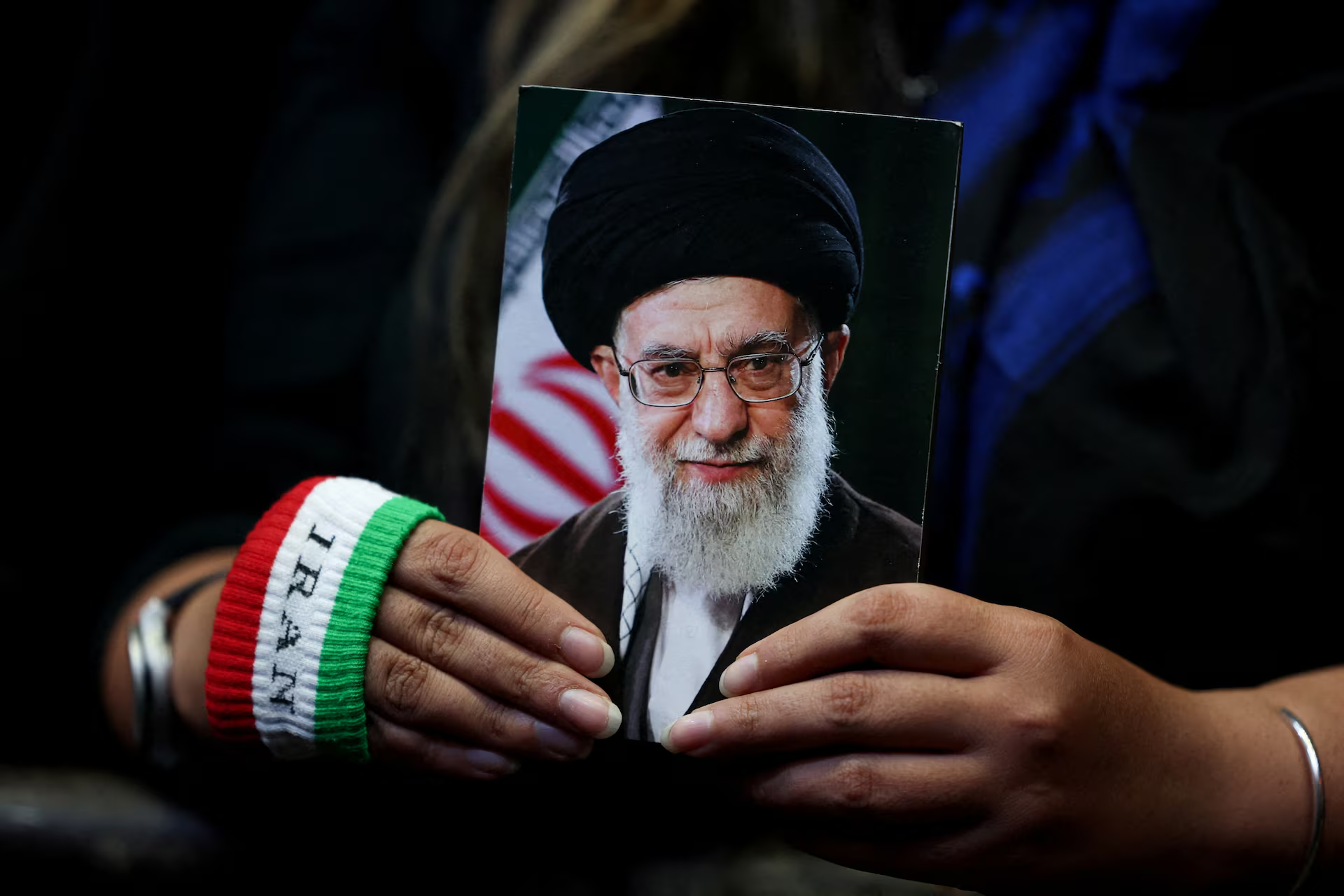
The revelation has raised a few questions but first, let us see who Soleimani was. Qasem Soleimani, an Iranian military officer, who remained the commander of the IRGC’s elite Quds Force, from 1998 till his assassination in 2020, was considered the second most powerful person in Iran, next to the Supreme Leader Ali Khamenei. According to an American national security and intelligence analyst, ‘he has been in combat his entire life. His soldiers love him. He is a quiet, charismatic guy, a strategic genius, and a tactical operator.’ Considered and loved in Iran as the ‘shadow commander’, he was viewed in Washington as an enemy who ‘made bombs that could penetrate armor, a deadly weapon against American forces fighting in Iraq’, a claim that Iran denied.
What went wrong between the US and Iran before Soleimani’s unfortunate death was for them to decide and act upon it as they deemed appropriate. Whether he did what Washington claims he did, had nothing to do with Islamabad. The assassination did not take place on Pakistani soil.
To clarify Pakistan’s official standpoint, the Foreign Office had expressed ‘deep concern’ over Soleimani’s death and stated that the development in the Middle East ‘seriously threatened peace and stability in the region.’ Islamabad called on all concerned parties ‘to exercise maximum restraint, engage constructively to de-escalate the situation’ while reminding the world that ‘respect for sovereignty and territorial integrity are the fundamental principles of the UN Charter, which should be adhered to’. Most importantly, Islamabad stressed the need to ‘avoid unilateral actions and use of force.’ To reinforce Pakistan’s considered opinion about the assassination, then Minister of Human Rights had urged all parties to ‘resolve issues through diplomatic means, following the UN Charter and international law.’
In this backdrop, it is hard to believe that the incumbent Prime Minister of Pakistan was, according to the former President of the United States of America, relishing the assassination of a friendly country’s beloved son, as the ‘biggest moment’ of his life. So much so that he stayed in ‘solitude’ for a full week.
First question: Why was this important ‘conversation’ concealed for around three years?
Second question: The said ‘conversation’ allegedly took place at the end of Trump’s Presidential tenure as Joe Biden was about to assume charge as the new President. Did he receive Khan’s call on his cell phone or was there any operator who connected them? As he was still the President, did anyone take note of this call?
Third question: The alleged ‘conversation’ took place between two Heads of Government on an important and sensitive subject. The contents of the ‘conversation’ have been revealed by a former and (perhaps) the future President of the United States. The remarks cannot be dismissed as casual ‘political’ talk to woo voters in a rally. The timing is also important particularly in view of the ongoing war in the Middle East, Iran-US relations, Pak-US relations, Pak-Iran relations and PTI’s chances of getting votes from those Pakistanis who keep Iran close to their hearts. What was the real motive behind this revelation?
Fourth question: Khan and his party are trying to gain some political space to participate in the upcoming general elections. Their focus, therefore, is somewhere else. Nevertheless, considering the sensitive nature of the subject, a clarification or a rebuttal might have been considered. Has the party decided not to say either ‘yes’ or ‘no’ and wait for the results of elections in the US and Pakistan?
Fifth question: In the hullabaloo of the new dynamics of international relations, should the world just keep ignoring what transpired between two sitting Heads of State on a subject of importance to three countries?
All over the world, Donald Trump is known for his interesting but meaningful remarks. Even his critics do not mind when he says something funny. If the idea was to look charming in front of some Houston-based ex-pat Pakistanis, he might have been able to bring some smiles on their faces. If the intent was to confirm that Khan was his buddy, hence, vote for him, he might have succeeded in making the point. If he threw a trump card towards Iran in making his intensions clear on Israel, the point must have been noted in the concerned quarters particularly in Tel Aviv and Tehran. However, all said and done, the ‘joke’ has provided Khan’s supporters with a vital piece of information. The biggest moment in their leader’s life has already arrived.
The writer is a former Ambassador of Pakistan and author of eight books in three languages. He can be reached at najmussaqib1960@msn.com.