The ongoing blockade of Gaza has pushed the enclave’s 2.3 million people to the brink of starvation, Cindy McCain, executive director of the U.N.’s World Food Program, warned on Sunday.
Israel has besieged the densely populated coastal region for almost two weeks, refusing to allow in food and medical aid amid fears it could fall into the hands of the militant group Hamas. As Israel intensified airstrikes over the weekend in preparation for a ground invasion, the first 20 aid trucks entered Gaza on Saturday after being blocked near the Egyptian-controlled Rafah border crossing.
But a lot more aid needs to be delivered, McCain told POLITICO.
“Right now we’re facing a catastrophe in the area with the inability to feed people and the inability for the people to find anything to eat at all,” McCain said in an interview Sunday. “These people are going to starve to death unless we can get in.”
Her warning was echoed by the regional director of the relief organization Mercy Corps, Arnaud Quemin, who told POLITICO a ceasefire is needed if there is going to be a sustainable flow of humanitarian aid into the Gaza.
Quemin warned that a spread of the conflict to neighboring countries, like Lebanon, already wracked by recent wars and deep in an economic crisis, would present the international community with a “daunting challenge.”
A second convoy of aid trucks entered the Egyptian side of the Rafah border crossing on Sunday, heading towards the Gaza Strip, Reuters reported, citing Egyptian security and humanitarian sources at Rafah. The trucks were carrying medical and food supplies, according to the report.
There are already an estimated 1.5 million Syrian refugees in Lebanon and any major displacement of the Lebanese from southern Lebanon in the event of full-scale hostilities breaking out between Israel and Iran-backed Hezbollah, a Hamas ally, would have catastrophic repercussions, he said on Sunday. “It would be horrible. I hope the all the major actors in the region understand that there aren’t any buffers.”
The Gaza Strip has been besieged by Israeli forces since October 9, when Israel’s Defense Minister Yoav Gallan moved to restrict all access to food, water and energy in the enclave in retaliation for a surprise incursion from the Hamas militant group that killed at least 1,400 people in Israel.
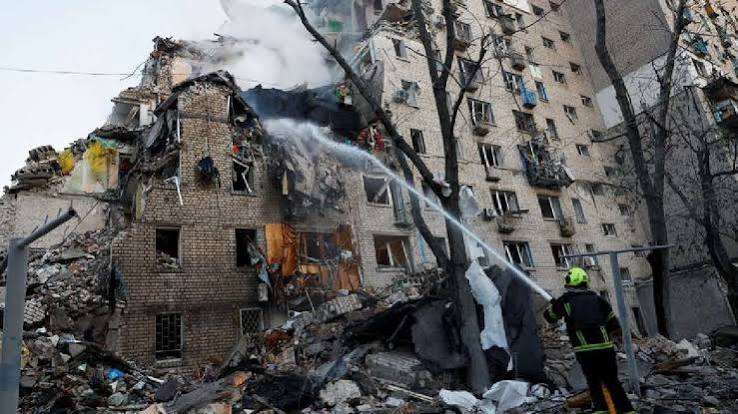
Israel’s retaliatory air and missile strikes have killed at least 4,385 Palestinians, including hundreds of children, and displaced more than a million people, Gaza’s health ministry said on Saturday.
Israel intensified its airstrikes Saturday night, killing more than 50 Palestinians, according to medical authorities in Gaza. The Israeli military warned that civilians who refused to relocate to the southern part of Gaza could be identified as sympathizers with a terrorist organization, Reuters reported.
Next stages of the war
Israeli military officials are warning that the near-constant aerial bombardment of the coastal enclave will only intensify in the coming days in preparation for a ground incursion into the Gaza.
“We will increase our strikes, minimize the risk to our troops in the next stages of the war, and we will intensify the strikes, starting from today,” Daniel Hagari, a spokesman for Israel Defense Forces (IDF), said on Saturday, adding that a ground operation in Gaza would be launched when conditions are right.
All eyes are now on the next move by the IDF, which has amassed huge numbers of troops outside Gaza and pounded the densely populated area with airstrikes in its attempt to eradicate Hamas following its deadly October 7 attack on Israel.
Meanwhile, Israel on Sunday launched an airstrike on the Al-Ansar Mosque in the city of Jenin in occupied West Bank, claiming militant Palestinian groups have been using it to plan “an imminent terror attack.” Violence has flared in the West Bank with Israel stepping up operations since the Hamas attack on southern Israel two weeks ago.
And according to Syria’s state news agency, Israeli airstrikes targeted both Damascus and Aleppo airports in the early hours Sunday, putting out of action the runways and forcing air traffic to be diverted to the city of Latakia. An Israel Defense Forces spokesperson declined to comment.
Israel earlier struck both airports on October 12 amid fears that Iran might use them to transfer weaponry to Hezbollah in readiness to launch a “second front” against Israel, something Iran and the Lebanese militant group have threatened to do if Israel fails to stop bombing Gaza.
Since the Gaza war erupted earlier this month, Hezbollah and Israel have been trading fire across the southern Lebanese border with increasing intensity. Both sides have largely confined their exchanges to military targets with Hezbollah acknowledging 15 of its fighters have been killed but claiming to have knocked out two Israeli tanks.