ISLAMABAD
The urea sector has the potential to become a top exporter with an exportable capacity of over 800,000 tonnes which has the potential to earn over $700 million a year.
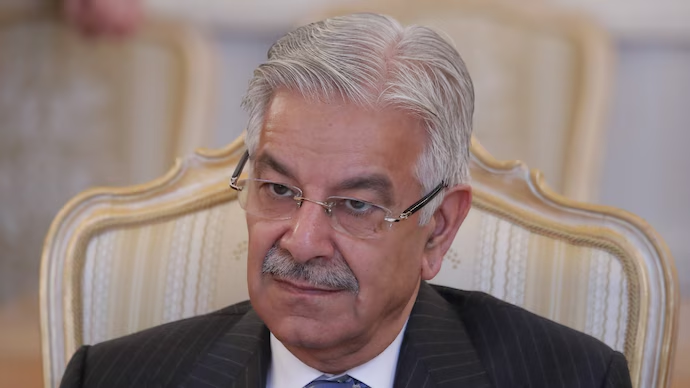
CFO of Engro Fertilizers Limited, Imran Ahmed said this while talking to the media on Thursday.
He said the govt’s policies to improve the agricultural landscape efforts have started to bear fruit as earnings of wheat and sugarcane farmers increased by 59 percent and 47 percent, respectively, in 2021 as compared to last year. He maintained that at the same time, the area under cultivation has reached a record high of 24.3 million hectares, depicting a significant growth of 2 million hectares in the last 2 years.
Moreover, better farm practices and increased use of hybrid seeds have led to enhanced yields. These factors have contributed to the growth in urea demand in the country which is now forecast to reach 6.3 million tonnes in 2022. He said that the Fertilizer Policy 2022 will enable a move to WACOG and leverage excess urea capacity in the country through exports.
He said that average local urea demand in Pakistan is around 6.1 MT whereas the nameplate capacity of urea production is now over 7 MT. Hence these investments have enabled the country to achieve self-sufficiency in urea production thereby ensuring food security in Pakistan.
He commended the efforts of the government of Punjab to effectively implement the subsidy mechanism through Kisan Cards which can go forward serve as a model for the rest of the provinces. He was of the view that the upcoming fertilizer policy should focus on leveraging the excess capacity in the country by allowing the industry to export urea.
Pakistan, being an agrarian state with a 20% GDP contribution and around 70% of the total population depending on agriculture for its livelihood, the role of the Urea Industry has been of pivotal importance. Prior to 1980-81, Pakistan imported well over 50% of its annual fertilizer requirements and had been a net importer till 2012. However, thanks to the Fertilizer Policy of 2001, which led to investment in new plants and an increase in production capacity.